Pearson+ LogoPearson+ Logo
Ch.10 Acids and Bases
McMurry - Fundamentals of GOB 8th Edition
McMurry8th EditionFundamentals of GOBISBN: 9780134015187Not the one you use?Change textbook
Chapter 10, Problem 39

What happens when a weak acid such as CH3CO2H is dissolved in water?

Verified step by step guidance
1
When a weak acid like CH₃CO₂H (acetic acid) is dissolved in water, it partially ionizes. This means that only a small fraction of the acid molecules donate protons (H⁺) to water, forming hydronium ions (H₃O⁺) and the conjugate base (CH₃CO₂⁻).
Write the chemical equilibrium equation to represent this process: CH3CO2H+H2OCH3CO2+H3O+.
Recognize that the equilibrium constant for this reaction is the acid dissociation constant, Kₐ, which is a measure of the strength of the weak acid. For acetic acid, Kₐ is small, indicating limited ionization.
Understand that the solution will contain a mixture of undissociated CH₃CO₂H molecules, CH₃CO₂⁻ ions, H₃O⁺ ions, and water molecules. The concentration of H₃O⁺ ions determines the acidity (pH) of the solution.
To calculate the pH or the concentrations of species in the solution, you would typically use the Kₐ value and set up an ICE (Initial, Change, Equilibrium) table to solve for the equilibrium concentrations of all species.

Verified video answer for a similar problem:

This video solution was recommended by our tutors as helpful for the problem above.
Video duration:
2m
Was this helpful?

Key Concepts

Here are the essential concepts you must grasp in order to answer the question correctly.

Weak Acids

Weak acids, like acetic acid (CH₃CO₂H), do not fully dissociate in water. Instead, they establish an equilibrium between the undissociated acid and its ions. This partial ionization is crucial for understanding their behavior in solution, as it affects pH and the acid's reactivity.
Recommended video:
Guided course
01:46
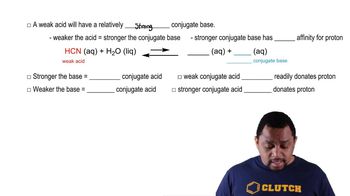
Acid and Base Strength Concept 4

Dissociation Equilibrium

When a weak acid dissolves in water, it reaches a state of dissociation equilibrium, represented by the equation CH₃CO₂H ⇌ CH₃CO₂⁻ + H⁺. This means that some molecules remain as undissociated acid while others dissociate into ions, influencing the concentration of hydrogen ions and thus the solution's acidity.
Recommended video:
Guided course
03:43
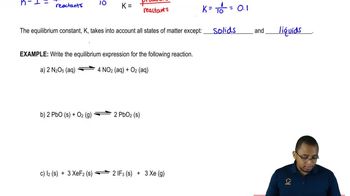
The Equilibrium Constant Example 1

pH and Acidity

The pH of a solution is a measure of its acidity, determined by the concentration of hydrogen ions (H⁺) present. In the case of weak acids, the pH is higher than that of strong acids at the same concentration due to their incomplete dissociation, which is essential for predicting the behavior of the solution in various chemical contexts.