Pearson+ LogoPearson+ Logo
Ch.2 Atoms and the Periodic Table
McMurry - Fundamentals of GOB 8th Edition
McMurry8th EditionFundamentals of GOBISBN: 9780134015187Not the one you use?Change textbook
Chapter 2, Problem 65

What is the total number of orbitals in the third shell? The fourth shell?

Verified step by step guidance
1
Understand that the number of orbitals in a shell is determined by the principal quantum number (n). Each shell corresponds to a specific value of n (e.g., n = 3 for the third shell, n = 4 for the fourth shell).
Recall that the number of subshells in a shell is equal to n. For example, the third shell (n = 3) has three subshells: 3s, 3p, and 3d, while the fourth shell (n = 4) has four subshells: 4s, 4p, 4d, and 4f.
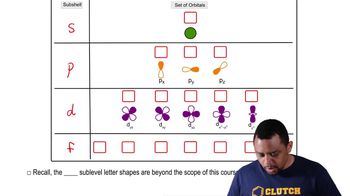
Each subshell contains a specific number of orbitals. The s subshell has 1 orbital, the p subshell has 3 orbitals, the d subshell has 5 orbitals, and the f subshell has 7 orbitals.
Calculate the total number of orbitals in the third shell by summing the orbitals in its subshells: 1 (from 3s) + 3 (from 3p) + 5 (from 3d). Similarly, calculate the total number of orbitals in the fourth shell by summing the orbitals in its subshells: 1 (from 4s) + 3 (from 4p) + 5 (from 4d) + 7 (from 4f).
Conclude that the total number of orbitals in a shell is given by the formula \( n^2 \), where n is the principal quantum number. For the third shell (n = 3), the total number of orbitals is \( 3^2 \). For the fourth shell (n = 4), the total number of orbitals is \( 4^2 \).

Verified video answer for a similar problem:

This video solution was recommended by our tutors as helpful for the problem above.
Video duration:
3m
Was this helpful?

Key Concepts

Here are the essential concepts you must grasp in order to answer the question correctly.

Electron Shells

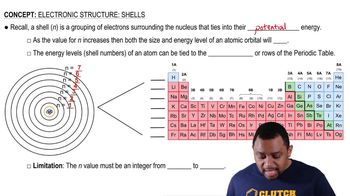
Electron shells are the regions around an atom's nucleus where electrons are likely to be found. Each shell is associated with a principal quantum number (n), which indicates its energy level and distance from the nucleus. The third shell corresponds to n=3, while the fourth shell corresponds to n=4.
Recommended video:
Guided course
02:29
Electronic Structure: Shells Concept 1

Orbitals

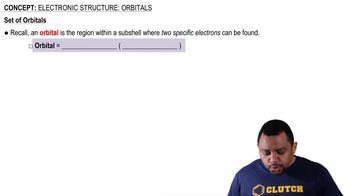
Orbitals are specific regions within electron shells where electrons are likely to be located. Each shell can contain multiple orbitals, which are categorized into types (s, p, d, f) based on their shape and energy. The number of orbitals in a shell is determined by the formula n^2, where n is the principal quantum number.
Recommended video:
Guided course
02:57
Electronic Structure: Orbitals Concept 3

Calculating Orbitals in Shells

To find the total number of orbitals in a given shell, you apply the formula n^2. For the third shell (n=3), the total number of orbitals is 3^2 = 9. For the fourth shell (n=4), the total number of orbitals is 4^2 = 16. This calculation is essential for understanding electron configuration and chemical bonding.
Recommended video:
Guided course
00:38
Electronic Structure: Orbitals Concept 2