Pearson+ LogoPearson+ Logo
Ch.3 Ionic Compounds
McMurry - Fundamentals of GOB 8th Edition
McMurry8th EditionFundamentals of GOBISBN: 9780134015187Not the one you use?Change textbook
Chapter 3, Problem 78

Explain why the hydride ion, H-, has a noble gas configuration.

Verified step by step guidance
1
Understand the concept of a noble gas configuration: A noble gas configuration refers to the electron arrangement of noble gases, which have completely filled outer electron shells, making them stable.
Recall the electron configuration of a hydrogen atom: A neutral hydrogen atom has one proton and one electron, with an electron configuration of 1s¹.
Analyze the hydride ion (H⁻): The hydride ion is formed when a hydrogen atom gains one additional electron, resulting in a total of two electrons.
Determine the electron configuration of H⁻: With two electrons, the electron configuration of H⁻ becomes 1s², which is the same as the electron configuration of helium, a noble gas.
Conclude why H⁻ has a noble gas configuration: The hydride ion achieves a stable, fully filled 1s orbital, identical to the electron configuration of helium, thus giving it a noble gas configuration.

Verified video answer for a similar problem:

This video solution was recommended by our tutors as helpful for the problem above.
Video duration:
2m
Was this helpful?

Key Concepts

Here are the essential concepts you must grasp in order to answer the question correctly.

Hydride Ion (H-)

The hydride ion (H-) is formed when a hydrogen atom gains an extra electron, resulting in a negatively charged ion. This process occurs because hydrogen, with one electron, seeks to achieve a more stable electronic configuration. The addition of an electron allows it to mimic the electron configuration of the nearest noble gas, helium.
Recommended video:
Guided course
02:31
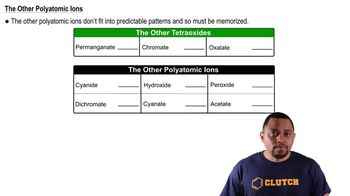
Polyatomic Ions

Noble Gas Configuration

Noble gas configuration refers to the electron arrangement of noble gases, which are characterized by having full outer electron shells. This full shell configuration makes noble gases highly stable and unreactive. For hydrogen, achieving a noble gas configuration means having two electrons in its outer shell, similar to helium, which is the closest noble gas.
Recommended video:
Guided course
01:08
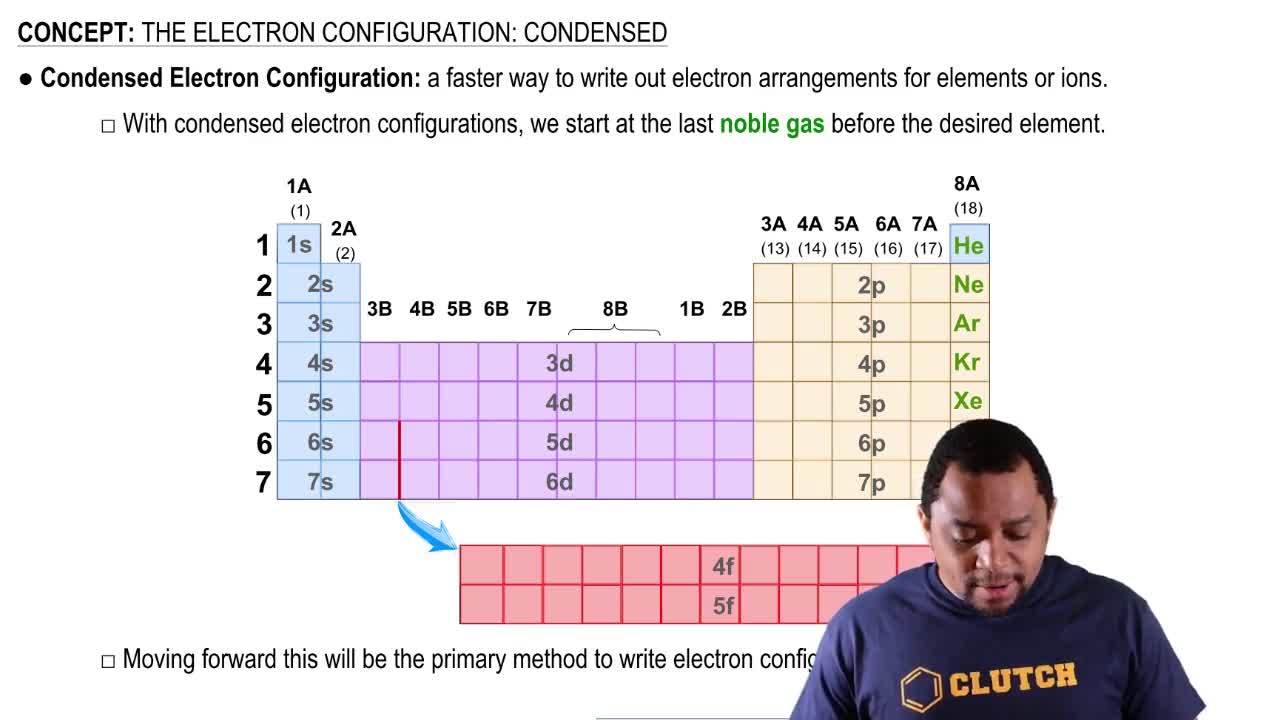
The Electron Configuration: Condensed

Electron Configuration

Electron configuration describes the distribution of electrons in an atom's orbitals. For hydrogen, the electron configuration is 1s¹, indicating one electron in the first shell. When it gains an electron to form H-, its configuration becomes 1s², which matches the stable configuration of helium, thus explaining why H- is considered to have a noble gas configuration.
Recommended video:
Guided course
01:08
The Electron Configuration: Condensed