Pearson+ LogoPearson+ Logo
Ch.4 Molecular Compounds
McMurry - Fundamentals of GOB 8th Edition
McMurry8th EditionFundamentals of GOBISBN: 9780134015187Not the one you use?Change textbook
Chapter 4, Problem 44c

Distinguish between the following:
c. A lone pair and a shared pair of electrons

Verified step by step guidance
1
Understand the concept of a lone pair: A lone pair refers to a pair of valence electrons that are not involved in bonding and are localized on a single atom. These electrons are not shared with another atom and remain as non-bonding electrons.
Understand the concept of a shared pair: A shared pair of electrons, also known as a bonding pair, refers to a pair of valence electrons that are shared between two atoms to form a covalent bond. These electrons contribute to the bond that holds the atoms together.
Visualize the difference: In a Lewis structure, lone pairs are typically represented as dots around the atom, while shared pairs are represented as a line (or two dots) between two atoms, indicating a covalent bond.
Relate to molecular geometry: Lone pairs can influence the shape of a molecule because they occupy space around the central atom, often causing bond angles to adjust. Shared pairs, on the other hand, directly determine the connectivity between atoms in the molecule.
Apply the knowledge: When analyzing a molecule, identify lone pairs and shared pairs by counting the valence electrons of each atom and determining which are involved in bonding and which remain unshared.

Verified video answer for a similar problem:

This video solution was recommended by our tutors as helpful for the problem above.
Video duration:
1m
Was this helpful?

Key Concepts

Here are the essential concepts you must grasp in order to answer the question correctly.

Lone Pair of Electrons

A lone pair of electrons refers to a pair of valence electrons that are not shared with another atom. These electrons are localized on a single atom and play a crucial role in determining the geometry and reactivity of molecules. For example, in water (H2O), the oxygen atom has two lone pairs that influence its bent shape.
Recommended video:
Guided course
00:45
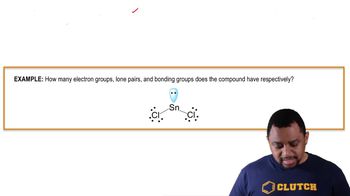
Valence Shell Electron Pair Repulsion Theory (Simplified) Example 2

Shared Pair of Electrons

A shared pair of electrons, also known as a bonding pair, occurs when two atoms share a pair of electrons to form a covalent bond. This sharing allows each atom to attain a more stable electron configuration, often resembling that of noble gases. For instance, in a hydrogen molecule (H2), each hydrogen atom shares one electron, resulting in a stable bond.
Recommended video:
Guided course
01:04
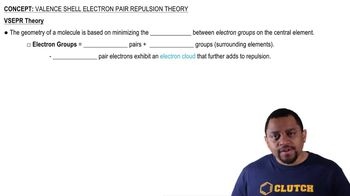
Valence Shell Electron Pair Repulsion Theory (Simplified) Concept 1

Covalent Bonding

Covalent bonding is a type of chemical bond that involves the sharing of electron pairs between atoms. This interaction typically occurs between nonmetals and is fundamental to the structure of many organic and inorganic compounds. The strength and number of shared pairs can affect the properties of the resulting molecule, such as its shape and reactivity.
Recommended video:
Guided course
01:04
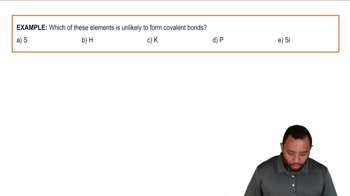
Covalent Bonds Example 1