Distinguish between the following: b. A structural formula and a condensed structure
Verified step by step guidance
1
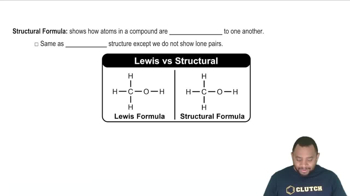
A structural formula is a detailed representation of a molecule that shows the arrangement of atoms and the bonds between them. It explicitly displays all the bonds (single, double, or triple) and the connectivity of atoms in the molecule. For example, in a structural formula, each hydrogen atom bonded to a carbon atom is shown individually.
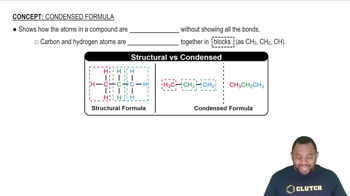
A condensed structure, on the other hand, is a simplified way of representing a molecule. It omits some or all of the bonds and groups atoms together to save space. For example, instead of showing each hydrogen atom bonded to a carbon atom, it might group them as CH3 or CH2.
To distinguish between the two, consider the level of detail: the structural formula provides a complete visual of the molecule's bonding, while the condensed structure provides a shorthand notation that is quicker to write but less detailed.
When writing a structural formula, you would explicitly draw all the bonds between atoms, such as H-C-H for a single carbon atom bonded to two hydrogens. In a condensed structure, you might write CH2 to represent the same group.
Both representations are useful in different contexts: structural formulas are helpful for understanding the molecule's geometry and bonding, while condensed structures are more practical for quickly conveying molecular information in text or compact formats.
Verified video answer for a similar problem:
This video solution was recommended by our tutors as helpful for the problem above
Video duration:
1m
Play a video:
Was this helpful?
Key Concepts
Here are the essential concepts you must grasp in order to answer the question correctly.
Structural Formula
A structural formula represents the arrangement of atoms within a molecule, showing how the atoms are bonded to each other. It provides a visual depiction of the molecular structure, including the types of bonds (single, double, or triple) and the connectivity between atoms. This format is essential for understanding the geometry and reactivity of the molecule.
A condensed structure is a simplified representation of a molecule that omits some of the bonds and shows the connectivity of atoms in a more compact form. In this format, groups of atoms are often grouped together, and hydrogen atoms attached to carbons are usually not explicitly shown. This makes it easier to read and write complex organic molecules quickly.
The key difference between structural formulas and condensed structures lies in the level of detail provided. Structural formulas give a complete picture of the molecular architecture, while condensed structures prioritize brevity and simplicity. Understanding both formats is crucial for chemists, as they serve different purposes in conveying molecular information.