Pearson+ LogoPearson+ Logo
Ch.7 Chemical Reactions: Energy, Rate and Equilibrium
McMurry - Fundamentals of GOB 8th Edition
McMurry8th EditionFundamentals of GOBISBN: 9780134015187Not the one you use?Change textbook
Chapter 7, Problem 3a

In photosynthesis, green plants convert carbon dioxide and water into glucose (C6H12O6) according to the following equation:
6 CO2(g) + 6 H2O(l) → C6H12O6(aq) + 6 O2(g)
a. Estimate ∆H for the reaction using bond dissociation energies from Table 7.1. Give your answer in kcal/mol and kJ/mol. (C6H12O6 has five C―C bonds, seven C―H bonds, seven C―O bonds, and five O―H bonds).

Verified step by step guidance
1
Step 1: Write down the balanced chemical equation for photosynthesis: 6 CO2(g) + 6 H2O(l) → C6H12O6(aq) + 6 O2(g). Identify the bonds broken in the reactants and the bonds formed in the products.
Step 2: Use the bond dissociation energy (BDE) values from Table 7.1 to calculate the total energy required to break all the bonds in the reactants. For CO2, each molecule has two C=O bonds, and for H2O, each molecule has two O―H bonds. Multiply the BDE of each bond by the number of bonds broken.
Step 3: Calculate the total energy released when bonds are formed in the products. For C6H12O6, account for five C―C bonds, seven C―H bonds, seven C―O bonds, and five O―H bonds. For O2, each molecule has one O=O bond. Multiply the BDE of each bond by the number of bonds formed.
Step 4: Determine the overall enthalpy change (∆H) for the reaction by subtracting the total energy of bonds formed from the total energy of bonds broken: ∆H = (Energy of bonds broken) - (Energy of bonds formed).
Step 5: Convert the calculated ∆H value from kcal/mol to kJ/mol using the conversion factor 1 kcal = 4.184 kJ. Report the final ∆H in both kcal/mol and kJ/mol.

Verified video answer for a similar problem:

This video solution was recommended by our tutors as helpful for the problem above.
Video duration:
14m
Was this helpful?

Key Concepts

Here are the essential concepts you must grasp in order to answer the question correctly.

Photosynthesis

Photosynthesis is the biochemical process by which green plants, algae, and some bacteria convert light energy into chemical energy, specifically glucose, using carbon dioxide and water. This process occurs primarily in the chloroplasts of plant cells and involves two main stages: the light-dependent reactions and the Calvin cycle. Understanding photosynthesis is crucial for grasping how plants produce energy and oxygen, which are vital for life on Earth.

Bond Dissociation Energy

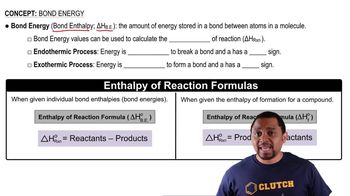
Bond dissociation energy (BDE) is the energy required to break a specific bond in a molecule, resulting in the formation of separate atoms or radicals. It is a key concept in thermochemistry, as it helps estimate the energy changes during chemical reactions. In the context of the given photosynthesis reaction, calculating ∆H involves summing the bond energies of the reactants and products to determine the overall energy change.
Recommended video:

Enthalpy Change (∆H)

Enthalpy change (∆H) refers to the heat content change of a system at constant pressure during a chemical reaction. It indicates whether a reaction is exothermic (releases heat, ∆H < 0) or endothermic (absorbs heat, ∆H > 0). In the context of photosynthesis, calculating ∆H using bond dissociation energies allows us to understand the energy dynamics of the reaction, which is essential for evaluating the efficiency of energy conversion in plants.
Recommended video:
Guided course
01:17
Physical & Chemical Changes