Pearson+ LogoPearson+ Logo
Ch.7 Chemical Reactions: Energy, Rate and Equilibrium
McMurry - Fundamentals of GOB 8th Edition
McMurry8th EditionFundamentals of GOBISBN: 9780134015187Not the one you use?Change textbook
Chapter 7, Problem 3b

In photosynthesis, green plants convert carbon dioxide and water into glucose (C6H12O6) according to the following equation:
6 CO2(g) + 6 H2O(l) → C6H12O6(aq) + 6 O2(g)
b. Is the reaction endothermic or exothermic?

Verified step by step guidance
1
Step 1: Understand the terms 'endothermic' and 'exothermic'. An endothermic reaction absorbs energy (usually in the form of heat) from its surroundings, while an exothermic reaction releases energy to its surroundings.
Step 2: Analyze the photosynthesis reaction. The equation provided is: 6 CO2(g) + 6 H2O(l) → C6H12O6(aq) + 6 O2(g). This reaction involves the formation of glucose (C6H12O6) and oxygen (O2) from carbon dioxide (CO2) and water (H2O).
Step 3: Recall that photosynthesis requires sunlight as an energy source. Plants absorb light energy (a form of energy input) to drive the reaction forward, indicating that energy is being absorbed.
Step 4: Recognize that the absorption of energy (in this case, light energy) is a characteristic of an endothermic reaction. The energy is used to break bonds in CO2 and H2O and form new bonds in glucose and oxygen.
Step 5: Conclude that the reaction is endothermic because it requires an input of energy (light) to proceed, rather than releasing energy to the surroundings.

Verified video answer for a similar problem:

This video solution was recommended by our tutors as helpful for the problem above.
Video duration:
1m
Was this helpful?

Key Concepts

Here are the essential concepts you must grasp in order to answer the question correctly.

Photosynthesis

Photosynthesis is the biochemical process by which green plants, algae, and some bacteria convert light energy into chemical energy. During this process, they use sunlight to transform carbon dioxide and water into glucose and oxygen. The overall reaction is represented by the equation: 6 CO2 + 6 H2O → C6H12O6 + 6 O2, highlighting the essential role of light energy in driving this transformation.

Endothermic and Exothermic Reactions

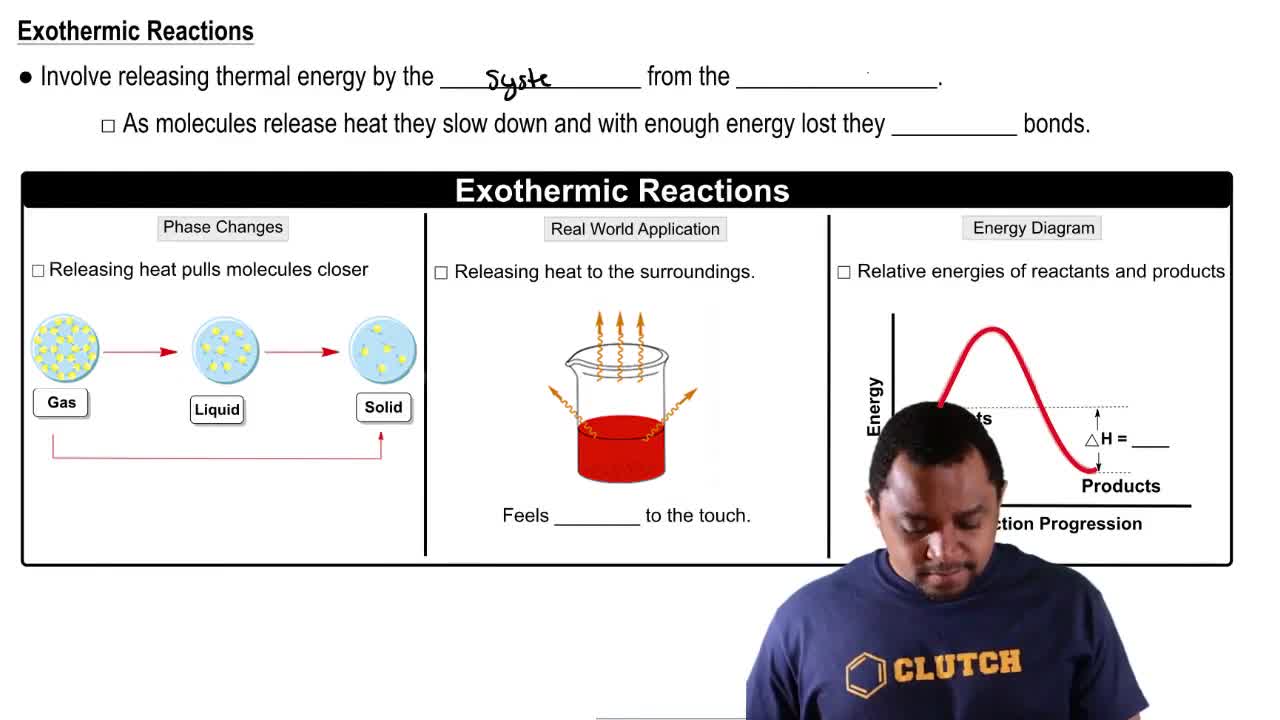
Chemical reactions can be classified as endothermic or exothermic based on their energy changes. Endothermic reactions absorb energy from their surroundings, resulting in a decrease in temperature, while exothermic reactions release energy, often in the form of heat, leading to an increase in temperature. Understanding this distinction is crucial for analyzing the energy dynamics of photosynthesis.
Recommended video:
Guided course
02:38
Endothermic & Exothermic Reactions

Energy Transfer in Photosynthesis

In photosynthesis, energy transfer occurs as light energy is captured by chlorophyll and converted into chemical energy stored in glucose. This process requires energy input, making it endothermic. The absorbed energy drives the conversion of carbon dioxide and water into glucose, illustrating how energy is essential for the synthesis of organic compounds in plants.
Recommended video:
Guided course
01:26
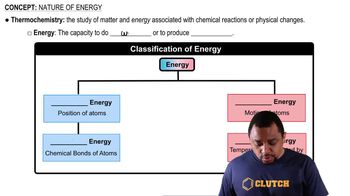
Nature of Energy