Pearson+ LogoPearson+ Logo
Ch.8 Gases, Liquids and Solids
McMurry - Fundamentals of GOB 8th Edition
McMurry8th EditionFundamentals of GOBISBN: 9780134015187Not the one you use?Change textbook
Chapter 8, Problem 1b

The change of state from liquid H2O to gaseous H2O has ∆H = +9.72 kcal/mol(+40.7 kJ/mol) and ∆S = -26.1 cal/(mol • K) [-109 J/(mol •K)].
b. What are the values of ∆H and ∆S (in kcal/mol and kJ/mol) for the change from gaseous to liquid H2O?

Verified step by step guidance
1
Step 1: Understand the problem. The given values of ∆H and ∆S are for the phase change from liquid H2O to gaseous H2O. To find the values for the reverse process (gaseous to liquid H2O), we need to reverse the signs of both ∆H and ∆S because the direction of the process is reversed.
Step 2: Reverse the sign of ∆H. The given ∆H for liquid to gas is +9.72 kcal/mol (or +40.7 kJ/mol). For the reverse process (gas to liquid), ∆H will be -9.72 kcal/mol (or -40.7 kJ/mol).
Step 3: Reverse the sign of ∆S. The given ∆S for liquid to gas is -26.1 cal/(mol • K) (or -109 J/(mol • K)). For the reverse process (gas to liquid), ∆S will be +26.1 cal/(mol • K) (or +109 J/(mol • K)).
Step 4: Ensure unit consistency. The values for ∆H and ∆S are already provided in both kcal/mol and kJ/mol, so no further unit conversion is necessary.
Step 5: Summarize the results. For the change from gaseous to liquid H2O, ∆H = -9.72 kcal/mol (-40.7 kJ/mol) and ∆S = +26.1 cal/(mol • K) [+109 J/(mol • K)].

Verified video answer for a similar problem:

This video solution was recommended by our tutors as helpful for the problem above.
Video duration:
1m
Was this helpful?

Key Concepts

Here are the essential concepts you must grasp in order to answer the question correctly.

Enthalpy Change (∆H)

Enthalpy change (∆H) refers to the heat content change of a system during a process at constant pressure. In the context of phase changes, a positive ∆H indicates that heat is absorbed when a substance transitions from a liquid to a gas, while a negative ∆H indicates heat is released during the reverse process. For the transition from gas to liquid, ∆H will be the negative of the value given for the liquid to gas transition.
Recommended video:
Guided course
01:17
Physical & Chemical Changes

Entropy Change (∆S)

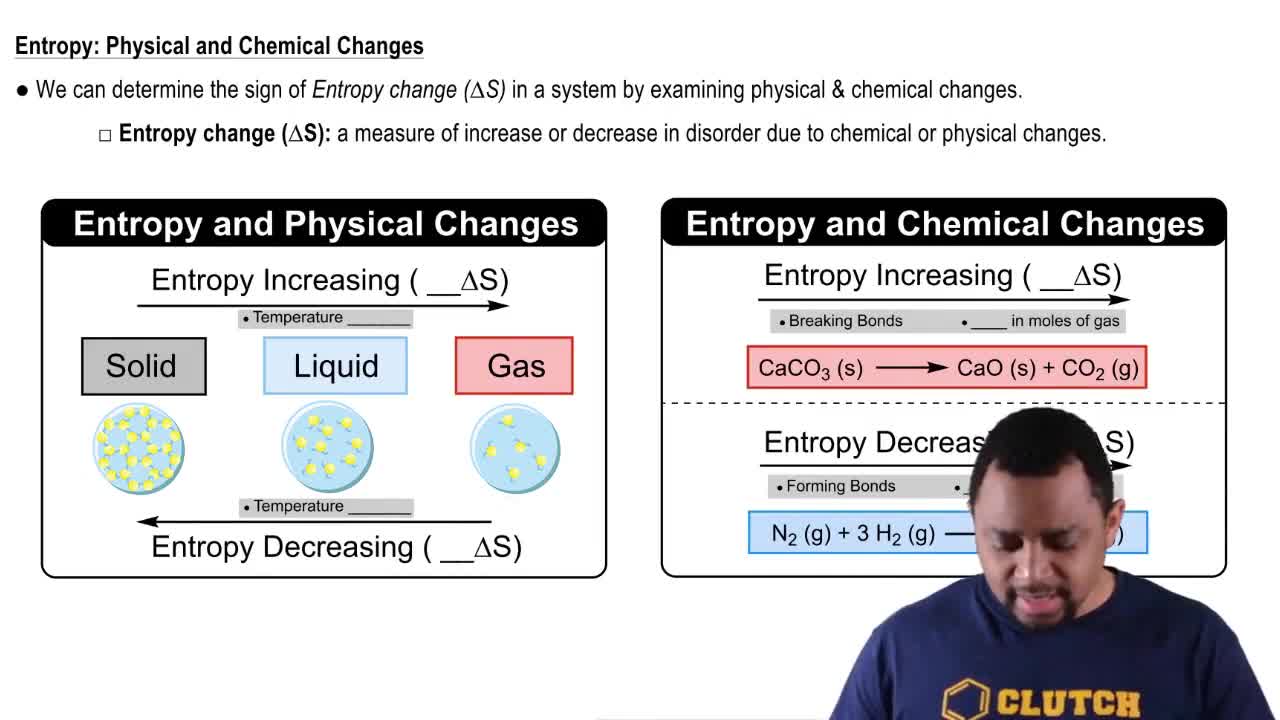
Entropy change (∆S) measures the degree of disorder or randomness in a system. A negative ∆S value, as seen in the transition from liquid to gas, indicates a decrease in disorder when moving from a gaseous state to a liquid state. Thus, for the reverse transition from gas to liquid, ∆S will be the negative of the value provided for the liquid to gas transition, reflecting the increase in order.
Recommended video:
Guided course
03:22
Entropy (Simplified) Concept 2

Thermodynamic Relationships

Thermodynamic relationships, particularly the principles of reversibility, dictate that the values of ∆H and ∆S for a process are equal in magnitude but opposite in sign when the process is reversed. This means that to find the values for the transition from gaseous to liquid H2O, one simply takes the negative of the given values for the liquid to gas transition, allowing for straightforward calculations in thermodynamic problems.
Recommended video:
Guided course
01:18
First Law of Thermodynamics