Pearson+ LogoPearson+ Logo
Ch.8 Gases, Liquids and Solids
McMurry - Fundamentals of GOB 8th Edition
McMurry8th EditionFundamentals of GOBISBN: 9780134015187Not the one you use?Change textbook
Chapter 8, Problem 1a

The change of state from liquid H2O to gaseous H2O has ∆H = +9.72 kcal/mol(+40.7 kJ/mol) and ∆S = -26.1 cal/(mol • K) [-109 J/(mol •K)].
a. Is the change from liquid to gaseous H2O favored or unfavored by ∆H? By ∆S?

Verified step by step guidance
1
Step 1: Understand the problem. The question asks whether the phase change from liquid H2O to gaseous H2O is favored or unfavored by enthalpy (∆H) and entropy (∆S). Positive ∆H indicates an endothermic process, while the sign of ∆S indicates whether the system's disorder increases or decreases.
Step 2: Analyze ∆H. The given value of ∆H is +9.72 kcal/mol (+40.7 kJ/mol). A positive ∆H means that energy is absorbed during the phase change, making the process endothermic. This suggests that the change is not energetically favored because it requires an input of energy.
Step 3: Analyze ∆S. The given value of ∆S is -26.1 cal/(mol • K) [-109 J/(mol • K)]. A negative ∆S indicates that the system's disorder decreases during the phase change. This is unexpected for a liquid-to-gas transition, as gases are typically more disordered than liquids. This suggests that the change is not entropically favored.
Step 4: Summarize the findings. Based on the analysis, the phase change from liquid H2O to gaseous H2O is not favored by ∆H because it requires energy input (endothermic), and it is also not favored by ∆S because the system's disorder decreases (negative entropy change).
Step 5: Note the broader context. While the process is not favored by ∆H or ∆S individually, the overall spontaneity of the process depends on the Gibbs free energy change (∆G = ∆H - T∆S). This equation considers both enthalpy and entropy contributions at a given temperature.

Verified video answer for a similar problem:

This video solution was recommended by our tutors as helpful for the problem above.
Video duration:
3m
Was this helpful?

Key Concepts

Here are the essential concepts you must grasp in order to answer the question correctly.

Enthalpy (∆H)

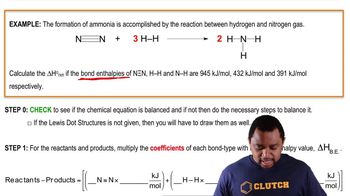
Enthalpy, represented as ∆H, is a measure of the heat content of a system at constant pressure. A positive ∆H indicates that the process is endothermic, meaning it absorbs heat from the surroundings. In the context of the phase change from liquid to gas, a positive ∆H (+9.72 kcal/mol) suggests that the transition requires energy input, which typically makes the process less favorable.
Recommended video:
Guided course
02:32
Bond Energy Example 1

Entropy (∆S)

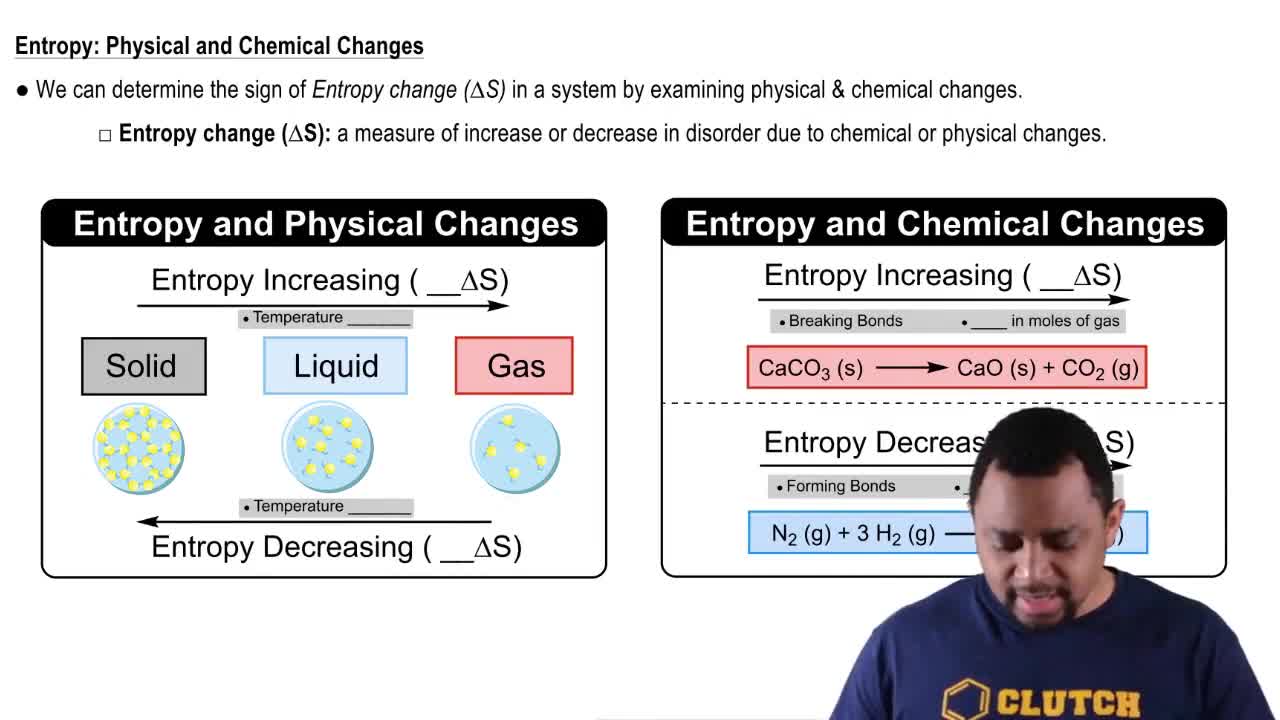
Entropy, denoted as ∆S, quantifies the degree of disorder or randomness in a system. A negative ∆S value indicates a decrease in disorder, which is the case when liquid water transitions to gas, as gas molecules are generally more disordered than liquid molecules. The negative ∆S (-26.1 cal/(mol • K)) suggests that this phase change is unfavorable in terms of increasing disorder.
Recommended video:
Guided course
03:22
Entropy (Simplified) Concept 2

Gibbs Free Energy (∆G)

Gibbs Free Energy, represented as ∆G, combines the effects of enthalpy and entropy to determine the spontaneity of a process. The relationship is given by the equation ∆G = ∆H - T∆S, where T is the temperature in Kelvin. A negative ∆G indicates a spontaneous process, while a positive ∆G indicates non-spontaneity. In this case, both a positive ∆H and a negative ∆S suggest that the transition from liquid to gaseous H2O is not favored.
Recommended video:
Guided course
01:04
Gibbs Free Energy (Simplified) Concept 3