
Textbook Question
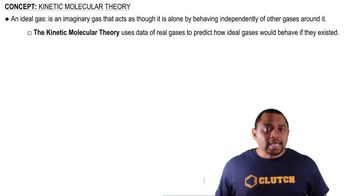
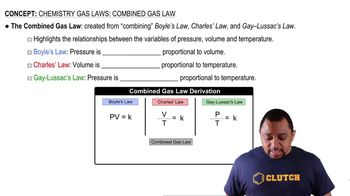
Which assumptions of the kinetic–molecular theory explain the behavior of gases described by Charles's law? Explain your answer.
1934
views

 Verified step by step guidance
 01:19
01:19
 01:43
01:43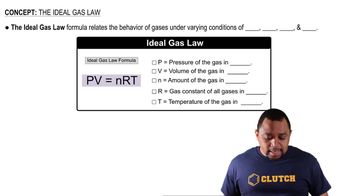 01:15
01:15Which assumptions of the kinetic–molecular theory explain the behavior of gases described by Charles's law? Explain your answer.
List four common units for measuring pressure.
A gas has a volume of 2.84 L at 1.00 atm and 0 °C. At what temperature does it have a volume of 7.50 L at 520 mmHg?
Which assumptions of the kinetic–molecular theory explain the behavior of gases described by Gay-Lussac's law? Explain your answer.
Assume that you have a sample of gas at 350 K in a sealed container, as represented in part (a). Which of the drawings (b)–(d) represents the gas after the temperature is lowered from 350 K to 150 K and if the gas has a boiling point of 200 K? Which drawing represents the gas at 150 K if the gas has a boiling point of 100 K?
<IMAGE>
Compare the ∆Hvap values for water, isopropyl alcohol, ether, and ammonia, and order them from lowest to highest. Explain the rank order based on intermolecular attractive forces.