Pearson+ LogoPearson+ Logo
Ch.9 Solutions
McMurry - Fundamentals of GOB 8th Edition
McMurry8th EditionFundamentals of GOBISBN: 9780134015187Not the one you use?Change textbook
Chapter 9, Problem 100b

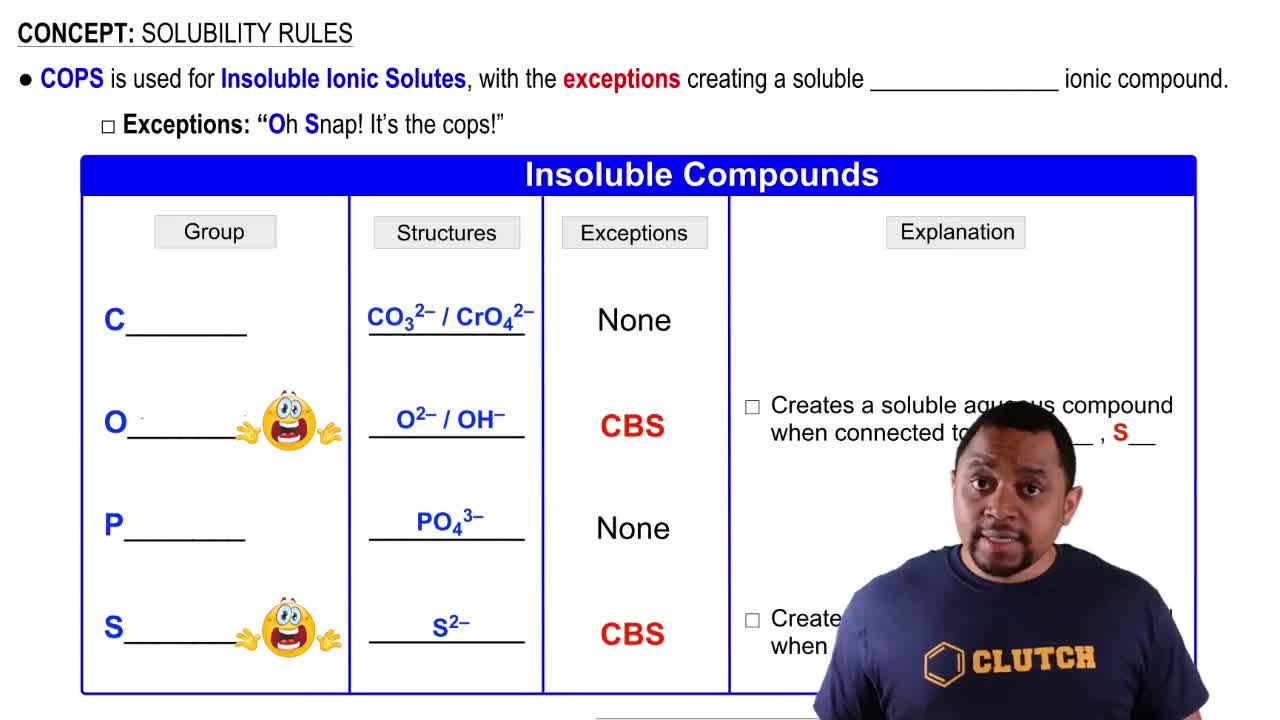
Many carbonate minerals are insoluble in water and appear in water pipes as 'scale.'
b. Why is scale formation typically only a problem in hot water pipes?

Verified step by step guidance
1
Understand the solubility of carbonate minerals: Carbonate minerals, such as calcium carbonate (CaCO₃), are generally sparingly soluble in water. Their solubility is influenced by temperature and the concentration of ions in the water.
Recall the effect of temperature on solubility: For many solids, solubility increases with temperature. However, for carbonate minerals like CaCO₃, solubility decreases as temperature increases. This is because the dissolution of CaCO₃ is an exothermic process, and higher temperatures shift the equilibrium toward the solid form (precipitation).
Consider the role of hot water pipes: In hot water pipes, the water temperature is elevated, which reduces the solubility of carbonate minerals. As a result, dissolved carbonate ions (CO₃²⁻) and calcium ions (Ca²⁺) in the water are more likely to combine and precipitate as solid CaCO₃, forming scale.
Account for the concentration of ions: Hard water, which contains high concentrations of calcium (Ca²⁺) and bicarbonate (HCO₃⁻) ions, is more prone to scale formation. When heated, bicarbonate ions decompose into carbonate ions (CO₃²⁻), further promoting the precipitation of CaCO₃.
Conclude why scale forms in hot water pipes: The combination of reduced solubility of carbonate minerals at higher temperatures and the increased availability of carbonate ions in hot water leads to the precipitation of scale, making it a common issue in hot water pipes.

Verified video answer for a similar problem:

This video solution was recommended by our tutors as helpful for the problem above.
Video duration:
7m
Was this helpful?

Key Concepts

Here are the essential concepts you must grasp in order to answer the question correctly.

Solubility of Carbonate Minerals

Carbonate minerals, such as calcium carbonate, have varying solubility in water depending on temperature and pressure. Generally, these minerals are more soluble in cold water than in hot water. As water temperature increases, the solubility of these minerals decreases, leading to precipitation and the formation of scale in hot water pipes.
Recommended video:
Guided course
02:08
Solubility Rules

Temperature Effects on Scale Formation

In hot water systems, the elevated temperatures promote the precipitation of dissolved minerals as they exceed their solubility limits. This process is exacerbated in hot water pipes, where the constant heat encourages the formation of scale, which can accumulate and restrict water flow, leading to maintenance issues.
Recommended video:
Guided course
04:38
Solubility: Temperature Effect Concept 1

Water Chemistry and pH Levels

The chemistry of water, including its pH level, significantly influences the solubility of carbonate minerals. Higher temperatures can alter the pH, making the water more alkaline, which further reduces the solubility of calcium carbonate. This change in water chemistry is a key factor in the increased likelihood of scale formation in hot water pipes.
Recommended video:
Guided course
02:09
pH and pOH Calculations