Nalorphine, a relative of morphine, is used to combat withdrawal symptoms in heroin users. How many milliliters of a 0.40% (m/v) solution of nalorphine must be injected to obtain a dose of 1.5 mg?
Ch.9 Solutions
Chapter 9, Problem 64
What is the concentration of a NaCl solution, in (m/v)%, prepared by diluting 65 mL of a saturated solution, which has a concentration of 37 (m/v)%, to 480 mL?
Verified step by step guidance1
Understand the problem: We are tasked with finding the new concentration of a NaCl solution in (m/v)% after diluting a given volume of a saturated solution to a larger volume. The key concept here is the dilution formula, which states that the amount of solute remains constant before and after dilution.
Write the dilution formula: \( C_1 V_1 = C_2 V_2 \), where \( C_1 \) is the initial concentration (37 (m/v)%), \( V_1 \) is the initial volume (65 mL), \( C_2 \) is the final concentration (what we are solving for), and \( V_2 \) is the final volume (480 mL).
Rearrange the formula to solve for \( C_2 \): \( C_2 = \frac{C_1 V_1}{V_2} \). This equation allows us to calculate the final concentration after dilution.
Substitute the known values into the formula: \( C_2 = \frac{(37 \text{ (m/v)%})(65 \text{ mL})}{480 \text{ mL}} \). Ensure that the units for volume are consistent (both in mL).
Simplify the expression to calculate \( C_2 \). The result will give the final concentration of the NaCl solution in (m/v)% after dilution.

Verified video answer for a similar problem:
This video solution was recommended by our tutors as helpful for the problem above.
Video duration:
2mWas this helpful?
Key Concepts
Here are the essential concepts you must grasp in order to answer the question correctly.
Concentration (m/v)%
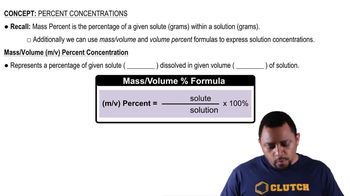
Concentration expressed as mass/volume percentage (m/v)% indicates the mass of solute in grams per 100 mL of solution. For example, a 37 (m/v)% NaCl solution contains 37 grams of NaCl in 100 mL of solution. This measurement is crucial for understanding how much solute is present in a given volume of solvent.
Recommended video:
Guided course
Percent Concentrations Concept 1
Dilution
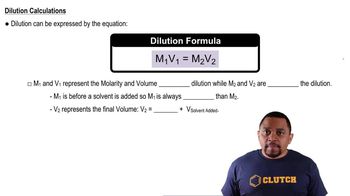
Dilution is the process of reducing the concentration of a solute in a solution, typically by adding more solvent. The dilution equation, C1V1 = C2V2, relates the initial concentration and volume (C1 and V1) to the final concentration and volume (C2 and V2). This concept is essential for calculating the new concentration after mixing solutions.
Recommended video:
Guided course
Dilutions
Saturated Solution
A saturated solution is one in which the maximum amount of solute has been dissolved at a given temperature, resulting in an equilibrium between dissolved and undissolved solute. In this context, the initial saturated solution of NaCl at 37 (m/v)% serves as the starting point for dilution, influencing the final concentration of the diluted solution.
Recommended video:
Guided course
Solutions
Related Practice
Textbook Question
1107
views
Textbook Question
Sodium thiosulfate (Na2S2O3) the major component in photographic fixer solution, reacts with silver bromide to dissolve it according to the following reaction:
AgBr(s) + 2 Na2S2O3(aq) → Na3Ag(S2O3)2(aq) + NaBr(aq)
b. How many mL of 0.02 M Na2S2O3 contain this number of moles?
1717
views
Textbook Question
An aqueous solution that contains 285 ppm of potassium nitrate (KNO3) is being used to feed plants in a garden. What volume of this solution is needed to prepare 2.0 L of a solution that is 75 ppm in KNO3?
1474
views
Textbook Question
What is an electrolyte?
2571
views
Textbook Question
What does it mean when we say that the concentration of Ca2+ in blood is 3.0 mEq/L?
1599
views
Textbook Question
Calculate the mass needed for each of the following ion equivalents:
a. 0.25 Eq Ca2+
1154
views