Pearson+ LogoPearson+ Logo
Ch.12 Introduction to Organic Chemistry: Alkanes
McMurry - Fundamentals of GOB 8th Edition
McMurry8th EditionFundamentals of GOBISBN: 9780134015187Not the one you use?Change textbook
Chapter 12, Problem 75b

How many hydrogen atoms are needed to complete the hydrocarbon formulas for the following carbon backbones?
b. <IMAGE>

Verified step by step guidance
1
Identify the type of hydrocarbon (alkane, alkene, or alkyne) based on the carbon backbone provided. Alkanes have single bonds, alkenes have at least one double bond, and alkynes have at least one triple bond.
Use the general formula for the type of hydrocarbon to determine the number of hydrogen atoms. For alkanes, the formula is CnH2n+2; for alkenes, it is CnH2n; and for alkynes, it is CnH2n-2.
Count the number of carbon atoms (n) in the given carbon backbone. This will be used in the formula to calculate the number of hydrogen atoms.
Subtract any hydrogen atoms already present in the structure from the total number of hydrogen atoms calculated using the formula. This will give the number of additional hydrogen atoms needed.
Verify the structure to ensure that each carbon atom forms four bonds (following the octet rule) and that the total number of hydrogen atoms matches the calculated value.

Verified video answer for a similar problem:

This video solution was recommended by our tutors as helpful for the problem above.
Was this helpful?

Key Concepts

Here are the essential concepts you must grasp in order to answer the question correctly.

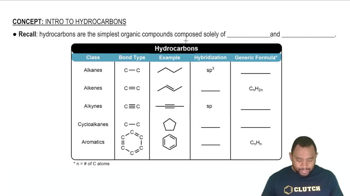
Hydrocarbons

Hydrocarbons are organic compounds consisting entirely of hydrogen and carbon atoms. They can be classified into aliphatic (straight or branched chains) and aromatic (ring structures) types. Understanding the structure of hydrocarbons is essential for determining how many hydrogen atoms are needed to satisfy the tetravalency of carbon, which forms four bonds.
Recommended video:
Guided course
4:29
Intro to Hydrocarbons Concept 1

Tetravalency of Carbon

Carbon has a tetravalent nature, meaning it can form four covalent bonds with other atoms. This property is crucial in hydrocarbon chemistry, as it dictates how many hydrogen atoms can bond with a given carbon backbone. For each carbon atom in a hydrocarbon, the number of hydrogen atoms required depends on the number of bonds formed with other carbon atoms or functional groups.
Recommended video:
Guided course
5:36
Amino Acid Catabolism: Carbon Atoms Concept 2

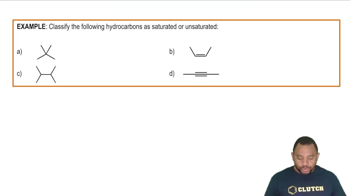
Saturation and Unsaturation

Saturation refers to hydrocarbons that contain only single bonds between carbon atoms, allowing for the maximum number of hydrogen atoms. Unsaturated hydrocarbons, on the other hand, contain double or triple bonds, which reduce the number of hydrogen atoms that can bond with the carbon backbone. Identifying whether a hydrocarbon is saturated or unsaturated is essential for calculating the required hydrogen atoms.
Recommended video:
Guided course
0:57
Saturated and Unsaturated Hydrocarbons Example 2