Pearson+ LogoPearson+ Logo
Ch.18 Amino Acids and Proteins
McMurry - Fundamentals of GOB 8th Edition
McMurry8th EditionFundamentals of GOBISBN: 9780134015187Not the one you use?Change textbook
Chapter 18, Problem 25a

Complete the following two sentences with either globular or fibrous:
a. Proteins with secondary structure composed primarily of alpha-helix are___________ proteins.

Verified step by step guidance
1
Understand the two main types of protein structures: globular and fibrous. Globular proteins are typically compact, spherical, and soluble in water, while fibrous proteins are elongated, insoluble, and provide structural support.
Recall that the secondary structure of proteins refers to the local folding patterns of the polypeptide chain, such as alpha-helices and beta-sheets.
Recognize that alpha-helices are a common feature in fibrous proteins, which are often involved in structural roles, such as keratin in hair and collagen in connective tissues.
Note that globular proteins, on the other hand, often have a mix of alpha-helices and beta-sheets and are involved in dynamic functions like enzymatic activity or transport.
Based on the description of the secondary structure being primarily alpha-helix, identify that the correct term to complete the sentence is 'fibrous' proteins.

Verified video answer for a similar problem:

This video solution was recommended by our tutors as helpful for the problem above.
Was this helpful?

Key Concepts

Here are the essential concepts you must grasp in order to answer the question correctly.

Globular Proteins

Globular proteins are typically spherical in shape and are soluble in water. They play crucial roles in various biological functions, including enzyme activity, transport, and immune responses. Their structure is often stabilized by hydrophilic interactions on the outside and hydrophobic interactions on the inside, allowing them to function effectively in aqueous environments.
Recommended video:
Guided course
2:01
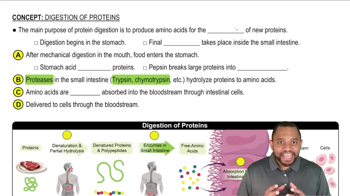
Digestion of Proteins Concept 1

Fibrous Proteins

Fibrous proteins are elongated and insoluble in water, providing structural support and strength to cells and tissues. They are characterized by repetitive sequences of amino acids that form long chains, which can aggregate to form fibers. Examples include collagen in connective tissues and keratin in hair and nails, which contribute to the mechanical properties of these structures.
Recommended video:
Guided course
2:01
Digestion of Proteins Concept 1

Alpha-Helix Structure

The alpha-helix is a common secondary structure in proteins, characterized by a right-handed coil where each turn of the helix is stabilized by hydrogen bonds between the backbone amide and carbonyl groups. This structure is crucial for the overall stability and functionality of globular proteins, as it contributes to their three-dimensional shape and interactions with other molecules.
Recommended video:
Guided course
2:03
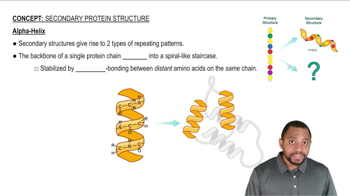
Alpha-Helix Concept 2