Pearson+ LogoPearson+ Logo
Ch.18 Amino Acids and Proteins
McMurry - Fundamentals of GOB 8th Edition
McMurry8th EditionFundamentals of GOBISBN: 9780134015187Not the one you use?Change textbook
Chapter 18, Problem 30c

For each of the conjugated proteins described, identify to which class of conjugated protein it belongs.
c. Phosphate groups are attached to this protein.

Verified step by step guidance
1
Understand the concept of conjugated proteins: Conjugated proteins are proteins that consist of a protein part (called the apoprotein) and a non-protein component (called the prosthetic group). The classification of conjugated proteins depends on the type of prosthetic group attached.
Identify the prosthetic group in the given problem: The problem states that phosphate groups are attached to the protein. This indicates that the prosthetic group is a phosphate group.
Recall the class of conjugated proteins associated with phosphate groups: Proteins with phosphate groups as their prosthetic group are classified as phosphoproteins.
Relate the information to the classification: Since the protein described in the problem has phosphate groups attached, it belongs to the class of phosphoproteins.
Conclude the classification: Based on the analysis, the protein described is a phosphoprotein, as its prosthetic group is a phosphate group.

Verified video answer for a similar problem:

This video solution was recommended by our tutors as helpful for the problem above.
Was this helpful?

Key Concepts

Here are the essential concepts you must grasp in order to answer the question correctly.

Conjugated Proteins

Conjugated proteins are complex molecules formed by the combination of a protein with a non-protein component, known as a prosthetic group. These non-protein components can include carbohydrates, lipids, or inorganic molecules, which contribute to the protein's function and properties. Understanding the classification of conjugated proteins is essential for identifying their roles in biological systems.
Recommended video:
Guided course
2:01
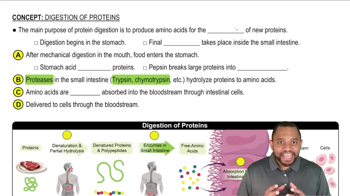
Digestion of Proteins Concept 1

Phosphorylation

Phosphorylation is a biochemical process involving the addition of phosphate groups to a protein, which can alter the protein's function, activity, or localization. This modification is crucial in regulating various cellular processes, including signal transduction and metabolic pathways. Proteins that undergo phosphorylation are often classified as phosphoproteins, a specific type of conjugated protein.
Recommended video:
Guided course
0:51
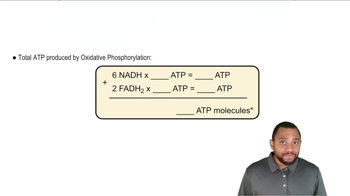
Oxidative Phosphorylation Concept 2

Classes of Conjugated Proteins

Conjugated proteins can be classified into several categories based on their prosthetic groups. Common classes include glycoproteins (with carbohydrate groups), lipoproteins (with lipid components), and metalloproteins (with metal ions). Identifying the class of a conjugated protein, such as one modified by phosphate groups, helps in understanding its biological function and interactions within the cell.
Recommended video:
Guided course
2:01
Digestion of Proteins Concept 1