Pearson+ LogoPearson+ Logo
Ch.20 Carbohydrates
McMurry - Fundamentals of GOB 8th Edition
McMurry8th EditionFundamentals of GOBISBN: 9780134015187Not the one you use?Change textbook
Chapter 20, Problem 20

During the digestion of starch from potatoes, the enzyme α-amylase catalyzes the hydrolysis of starch into maltose. Subsequently, the enzyme maltase catalyzes the hydrolysis of maltose into two glucose units. Write an equation (in words) for the enzymatic conversion of starch to glucose. Classify each of the carbohydrates in the equation as a disaccharide, monosaccharide, or polysaccharide.

Verified step by step guidance
1
Step 1: Understand the enzymatic process. The problem describes two enzymatic reactions: (1) α-amylase catalyzes the breakdown of starch into maltose, and (2) maltase catalyzes the breakdown of maltose into glucose. These reactions involve hydrolysis, where water is used to break chemical bonds.
Step 2: Write the first reaction in words. Starch, a polysaccharide, is hydrolyzed by the enzyme α-amylase to produce maltose, which is a disaccharide. The reaction can be written as: 'Starch + Water → Maltose (catalyzed by α-amylase)'.
Step 3: Write the second reaction in words. Maltose, a disaccharide, is hydrolyzed by the enzyme maltase to produce two glucose molecules, which are monosaccharides. The reaction can be written as: 'Maltose + Water → 2 Glucose (catalyzed by maltase)'.
Step 4: Combine the two reactions into a single overall equation. The enzymatic conversion of starch to glucose can be summarized as: 'Starch + Water → Glucose (via α-amylase and maltase)'.
Step 5: Classify the carbohydrates. Starch is a polysaccharide, maltose is a disaccharide, and glucose is a monosaccharide. This classification is based on the number of sugar units in each molecule: polysaccharides have many, disaccharides have two, and monosaccharides have one.

Verified video answer for a similar problem:

This video solution was recommended by our tutors as helpful for the problem above.
Video duration:
1m
Was this helpful?

Key Concepts

Here are the essential concepts you must grasp in order to answer the question correctly.

Enzymatic Hydrolysis

Enzymatic hydrolysis is a biochemical process where enzymes catalyze the breakdown of complex molecules into simpler ones by adding water. In the context of starch digestion, α-amylase initiates this process by breaking down starch, a polysaccharide, into maltose, a disaccharide. This reaction is crucial for converting carbohydrates into absorbable sugars.
Recommended video:
Guided course
3:09
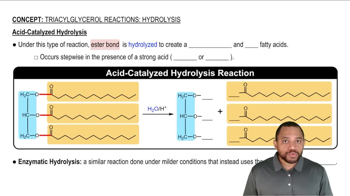
Triacylglycerol Reactions: Hydrolysis Concept 1

Carbohydrate Classification

Carbohydrates are classified into three main categories: monosaccharides, disaccharides, and polysaccharides. Monosaccharides are the simplest form, consisting of single sugar units like glucose. Disaccharides, such as maltose, are formed from two monosaccharides, while polysaccharides, like starch, are long chains of monosaccharide units. Understanding these classifications is essential for analyzing the enzymatic conversion process.
Recommended video:
Guided course
1:29
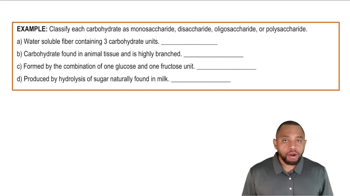
Classification of Carbohydrates Example 1

Enzyme Function

Enzymes are biological catalysts that speed up chemical reactions in living organisms without being consumed in the process. In starch digestion, α-amylase and maltase are specific enzymes that facilitate the conversion of starch to glucose by lowering the activation energy required for the hydrolysis reactions. Their specificity and efficiency are vital for proper digestion and nutrient absorption.
Recommended video:
Guided course
02:16
Logarithmic Functions