Pearson+ LogoPearson+ Logo
Ch.22 Carbohydrate Metabolism
McMurry - Fundamentals of GOB 8th Edition
McMurry8th EditionFundamentals of GOBISBN: 9780134015187Not the one you use?Change textbook
Chapter 22, Problem 36

What three products are formed from pyruvate under aerobic, anaerobic, and fermentation conditions?

Verified step by step guidance
1
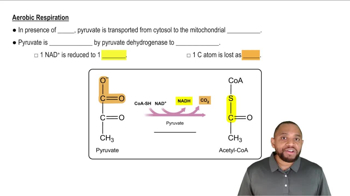
Under aerobic conditions, pyruvate is transported into the mitochondria where it undergoes oxidative decarboxylation by the enzyme pyruvate dehydrogenase. This process converts pyruvate into acetyl-CoA, releasing one molecule of CO₂ and reducing NAD⁺ to NADH.
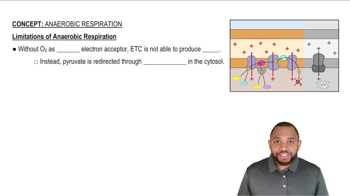
Under anaerobic conditions in animal cells, pyruvate is reduced to lactate in the cytoplasm by the enzyme lactate dehydrogenase. This process regenerates NAD⁺ from NADH, allowing glycolysis to continue in the absence of oxygen.
Under fermentation conditions in yeast and some microorganisms, pyruvate is converted into ethanol and CO₂. This occurs in two steps: first, pyruvate is decarboxylated to acetaldehyde by the enzyme pyruvate decarboxylase, releasing CO₂. Then, acetaldehyde is reduced to ethanol by alcohol dehydrogenase, regenerating NAD⁺.
Each of these pathways serves a specific purpose: aerobic respiration maximizes ATP production, anaerobic respiration allows glycolysis to continue in low oxygen conditions, and fermentation enables energy production in microorganisms under anaerobic conditions.
To summarize, the three products formed from pyruvate are: acetyl-CoA (aerobic), lactate (anaerobic), and ethanol + CO₂ (fermentation).

Verified video answer for a similar problem:

This video solution was recommended by our tutors as helpful for the problem above.
Video duration:
3m
Was this helpful?

Key Concepts

Here are the essential concepts you must grasp in order to answer the question correctly.

Pyruvate

Pyruvate is a key intermediate in cellular metabolism, produced from glucose during glycolysis. It serves as a crucial junction point for various metabolic pathways, determining the fate of glucose-derived energy depending on the availability of oxygen.
Recommended video:
Guided course
1:38
Pyruvate Oxidation Concept 2

Aerobic Respiration

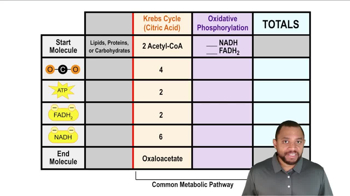
Aerobic respiration is a metabolic process that occurs in the presence of oxygen, where pyruvate is converted into acetyl-CoA and enters the citric acid cycle. This process generates a significant amount of ATP, carbon dioxide, and water as byproducts, making it highly efficient for energy production.
Recommended video:
Guided course
2:46
Aerobic Respiration Summary Concept 1

Anaerobic Respiration and Fermentation

Anaerobic respiration and fermentation occur in the absence of oxygen. In anaerobic respiration, pyruvate can be converted into substances like lactic acid or ethanol, depending on the organism. Fermentation is a specific type of anaerobic process that allows for ATP production without the electron transport chain, resulting in products like ethanol in yeast or lactic acid in muscle cells.
Recommended video:
Guided course
1:47
Anaerobic Respiration Concept 1