Pearson+ LogoPearson+ Logo
Ch.10 Acids and Bases and Equilibrium
Timberlake - Chemistry: An Introduction to General, Organic, and Biological Chemistry 14th Edition
Timberlake14thChemistry: An Introduction to General, Organic, and Biological ChemistryISBN: 9781292472249Not the one you use?Change textbook
Chapter 10, Problem 108b

Determine each of the following for a 0.100 M HBr solution:
b. pH

Verified step by step guidance
1
Step 1: Recognize that HBr is a strong acid, meaning it completely dissociates in water. This implies that the concentration of H⁺ ions ([H⁺]) in the solution is equal to the initial concentration of HBr.
Step 2: Write the relationship between the concentration of H⁺ ions and the pH of the solution. The formula is: pH=-log(H+)
Step 3: Substitute the given concentration of HBr (0.100 M) into the formula for [H⁺], since [H⁺] = 0.100 M for a strong acid like HBr.
Step 4: Use the logarithmic function to calculate the pH. Specifically, take the negative logarithm (base 10) of the [H⁺] concentration: pH=-log(0.100)
Step 5: Interpret the result. The pH value will indicate the acidity of the solution, with lower values corresponding to higher acidity. Since HBr is a strong acid, the pH should be relatively low.

Verified video answer for a similar problem:

This video solution was recommended by our tutors as helpful for the problem above.
Video duration:
1m
Was this helpful?

Key Concepts

Here are the essential concepts you must grasp in order to answer the question correctly.

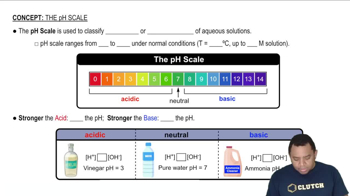
pH Scale

The pH scale measures the acidity or basicity of a solution, ranging from 0 to 14. A pH of 7 is neutral, while values below 7 indicate acidity and values above 7 indicate alkalinity. The scale is logarithmic, meaning each whole number change represents a tenfold change in hydrogen ion concentration.
Recommended video:

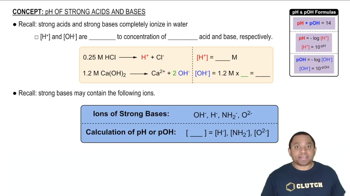
Strong Acids

Strong acids, like HBr, completely dissociate in water, releasing all their hydrogen ions (H+). This complete dissociation means that the concentration of the acid directly correlates with the concentration of H+ ions in the solution, making it straightforward to calculate the pH of strong acid solutions.
Recommended video:
Guided course
02:39
Strong Acids and Bases

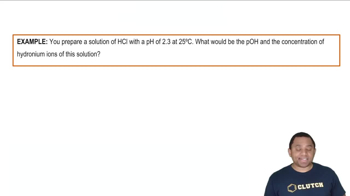
Calculating pH

To calculate the pH of a solution, the formula pH = -log[H+] is used, where [H+] is the concentration of hydrogen ions. For a 0.100 M HBr solution, since it fully dissociates, the [H+] is also 0.100 M, leading to a pH calculation of -log(0.100), which results in a pH of 1.00.
Recommended video:
Guided course
01:46
pH and pOH Example