Pearson+ LogoPearson+ Logo
Ch.17 Nucleic Acids and Protein Synthesis
Timberlake - Chemistry: An Introduction to General, Organic, and Biological Chemistry 14th Edition
Timberlake14thChemistry: An Introduction to General, Organic, and Biological ChemistryISBN: 9781292472249Not the one you use?Change textbook
Chapter 17, Problem 29

What is the function of the enzyme helicase in DNA replication?

Verified step by step guidance
1
Understand that DNA replication is the process by which a DNA molecule is copied to produce two identical DNA molecules, and enzymes play critical roles in this process.
Recognize that helicase is one of the key enzymes involved in DNA replication, and its primary function is to unwind the double-stranded DNA.
Helicase breaks the hydrogen bonds between the complementary base pairs (adenine-thymine and guanine-cytosine) in the DNA double helix, separating the two strands.
This unwinding creates a replication fork, which is the Y-shaped structure where the DNA strands are separated and replication occurs.
By unwinding the DNA, helicase provides single-stranded DNA templates that other enzymes, such as DNA polymerase, use to synthesize new complementary strands.

Verified video answer for a similar problem:

This video solution was recommended by our tutors as helpful for the problem above.
Video duration:
3m
Was this helpful?

Key Concepts

Here are the essential concepts you must grasp in order to answer the question correctly.

DNA Replication

DNA replication is the biological process by which a cell duplicates its DNA, ensuring that each new cell receives an exact copy of the genetic material. This process involves several key enzymes and proteins that work together to unwind the DNA double helix, synthesize new strands, and proofread the newly formed DNA to maintain genetic fidelity.
Recommended video:
Guided course
1:40
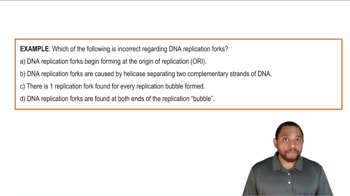
Intro to DNA Replication Example 2

Helicase

Helicase is an essential enzyme in DNA replication that unwinds the double-stranded DNA helix, separating the two strands to allow access for other enzymes involved in the replication process. By breaking the hydrogen bonds between the nucleotide bases, helicase creates two single-stranded templates that can be copied into new DNA strands.
Recommended video:
Guided course
3:07
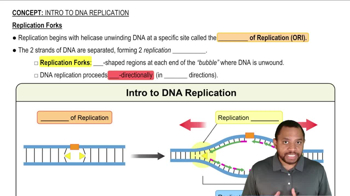
Intro to DNA Replication Concept 3

Enzyme Function

Enzymes are biological catalysts that speed up chemical reactions in living organisms. In the context of DNA replication, helicase's function is crucial as it facilitates the unwinding of DNA, which is a necessary step for the replication machinery to synthesize new DNA strands efficiently. Without helicase, the replication process would be significantly slower and less efficient.
Recommended video:
Guided course
02:16
Logarithmic Functions