Pearson+ LogoPearson+ Logo
Ch.4 Atoms and Elements
Timberlake - Chemistry: An Introduction to General, Organic, and Biological Chemistry 14th Edition
Timberlake14thChemistry: An Introduction to General, Organic, and Biological ChemistryISBN: 9781292472249Not the one you use?Change textbook
Chapter 4, Problem 82b

Match the subatomic particles (1 to 3) to each of the descriptions below:
1. protons
2. neutrons
3. electrons
b. surround the nucleus

Verified step by step guidance
1
Identify the three subatomic particles: protons, neutrons, and electrons. Protons and neutrons are located in the nucleus, while electrons are found outside the nucleus.
Understand the description provided: 'surround the nucleus.' This refers to the region outside the nucleus where subatomic particles are located.
Recall that electrons are negatively charged particles that move in regions of space called orbitals around the nucleus.
Match the description 'surround the nucleus' to the subatomic particle that fits this behavior, which is the electron.
Conclude that the correct match for the description 'surround the nucleus' is the subatomic particle labeled as '3. electrons.'

Verified video answer for a similar problem:

This video solution was recommended by our tutors as helpful for the problem above.
Video duration:
49s
Was this helpful?

Key Concepts

Here are the essential concepts you must grasp in order to answer the question correctly.

Subatomic Particles

Subatomic particles are the fundamental constituents of atoms, which include protons, neutrons, and electrons. Protons carry a positive charge and are found in the nucleus, while neutrons are neutral and also reside in the nucleus. Electrons, on the other hand, are negatively charged and orbit the nucleus in various energy levels.
Recommended video:
Guided course
01:25
Subatomic Particles (Simplified) Concept 1

Atomic Structure

The atomic structure refers to the arrangement of subatomic particles within an atom. The nucleus, composed of protons and neutrons, is at the center, while electrons occupy regions around the nucleus, known as electron shells or orbitals. This structure is crucial for understanding chemical behavior and bonding.
Recommended video:
Guided course
05:22
Atomic Theory

Electron Configuration

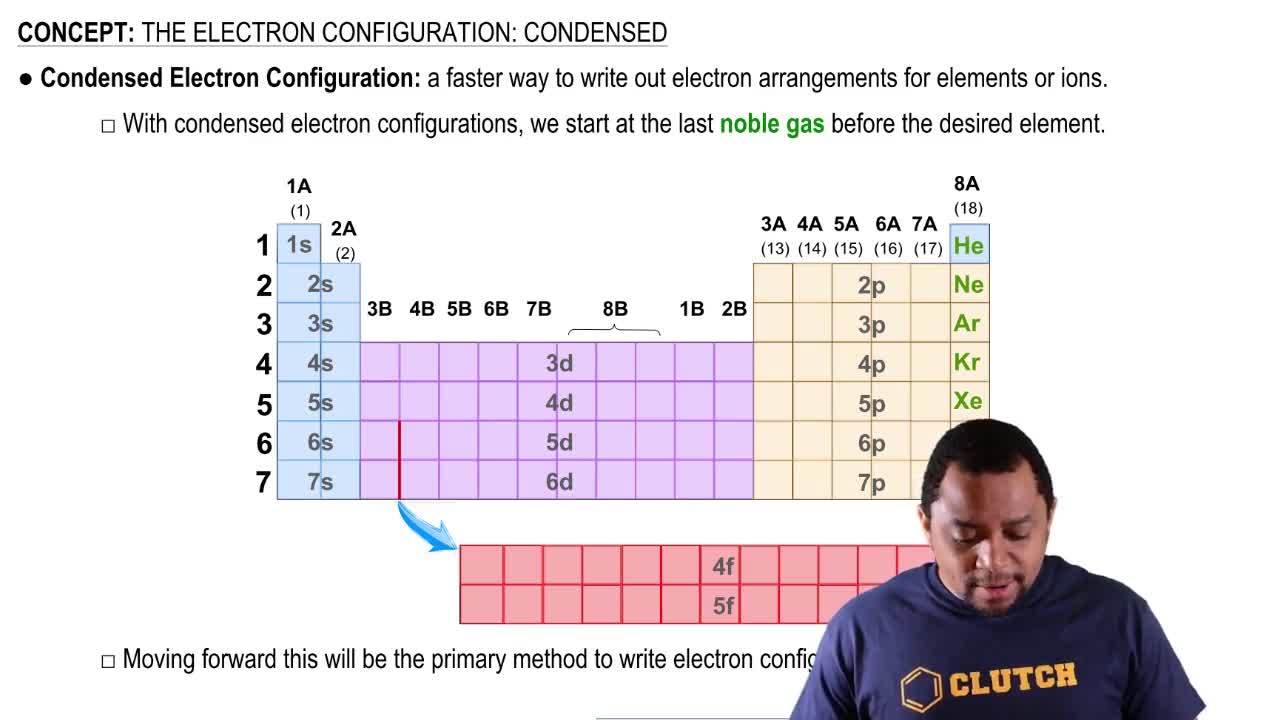
Electron configuration describes the distribution of electrons in an atom's electron shells. Electrons fill these shells based on specific rules, such as the Aufbau principle, which states that electrons occupy the lowest energy levels first. This configuration influences an atom's reactivity and the types of bonds it can form.
Recommended video:
Guided course
01:08
The Electron Configuration: Condensed