Pearson+ LogoPearson+ Logo
Ch.6 Ionic and Molecular Compounds
Timberlake - Chemistry: An Introduction to General, Organic, and Biological Chemistry 14th Edition
Timberlake14thChemistry: An Introduction to General, Organic, and Biological ChemistryISBN: 9781292472249Not the one you use?Change textbook
Chapter 6, Problem 151c

Classify each of the following as ionic or molecular, and name each:
a. Li2HPO4

Verified step by step guidance
1
Step 1: Identify the types of elements in the compound. Lithium (Li) is a metal, and the rest of the compound (HPO₄) contains nonmetals (hydrogen, phosphorus, and oxygen). Compounds containing metals and nonmetals are typically ionic.
Step 2: Confirm the ionic nature of the compound. Li₂HPO₄ is composed of lithium ions (Li⁺) and the hydrogen phosphate ion (HPO₄²⁻), which confirms it is an ionic compound.
Step 3: Name the cation (positive ion) first. Lithium (Li⁺) is a monatomic ion, so its name remains 'lithium.'
Step 4: Name the anion (negative ion) second. HPO₄²⁻ is a polyatomic ion called 'hydrogen phosphate.'
Step 5: Combine the names of the cation and anion. The name of the compound is 'lithium hydrogen phosphate.'

Verified video answer for a similar problem:

This video solution was recommended by our tutors as helpful for the problem above.
Video duration:
1m
Was this helpful?

Key Concepts

Here are the essential concepts you must grasp in order to answer the question correctly.

Ionic Compounds

Ionic compounds are formed when atoms transfer electrons, resulting in the formation of charged ions. These compounds typically consist of a metal and a non-metal, where the metal donates electrons and the non-metal accepts them. The electrostatic attraction between the oppositely charged ions holds the compound together. An example is lithium phosphate (Li₂HPO₄), which contains lithium ions and phosphate ions.
Recommended video:
Guided course
02:11
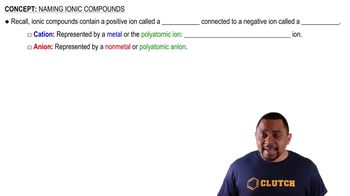
Naming Ionic Compounds

Molecular Compounds

Molecular compounds are formed when two or more non-metal atoms share electrons through covalent bonds. These compounds usually consist of discrete molecules rather than a lattice structure, and they can exist in various states (solid, liquid, gas) at room temperature. An example is water (H₂O), where hydrogen and oxygen atoms share electrons to form a stable molecule.
Recommended video:
Guided course
01:10
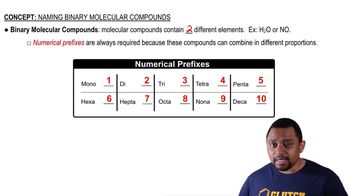
Naming Binary Molecular Compounds Concept 1

Nomenclature of Compounds

Nomenclature refers to the systematic naming of chemical compounds based on their composition and structure. For ionic compounds, the name typically includes the cation (positive ion) followed by the anion (negative ion), while molecular compounds use prefixes to indicate the number of atoms present. Understanding nomenclature is essential for accurately classifying and naming compounds like Li₂HPO₄, which is named lithium hydrogen phosphate.
Recommended video:
Guided course
02:11
Naming Ionic Compounds