Skip to main content
Introduction to Chemistry
My Course
Learn
Exam Prep
AI Tutor
Study Guides
Flashcards
Explore
Try the app
My Course
Learn
Exam Prep
AI Tutor
Study Guides
Flashcards
Explore
Try the app
Back
Molecular Polarity (Simplified) definitions
You can tap to flip the card.
Molecular Polarity
You can tap to flip the card.
👆
Molecular Polarity
Overall distribution of electrical charge across a covalent molecule, determined by both shape and bond polarities.
Track progress
Control buttons has been changed to "navigation" mode.
1/12
Related flashcards
Related practice
Recommended videos
Molecular Polarity (Simplified) quiz #1
Molecular Polarity (Simplified)
10 Terms
Molecular Polarity (Simplified)
10. Chemical Bonding
5 problems
Topic
Dipole Moment (Simplified)
10. Chemical Bonding
5 problems
Topic
10. Chemical Bonding - Part 1 of 2
12 topics
35 problems
Chapter
10. Chemical Bonding - Part 2 of 2
4 topics
12 problems
Chapter
Guided course
01:34
Molecular Polarity (Simplified) Concept 1
3483
views
23
rank
Guided course
01:09
Molecular Polarity (Simplified) Example 1
3156
views
16
rank
Terms in this set (12)
Hide definitions
Molecular Polarity
Overall distribution of electrical charge across a covalent molecule, determined by both shape and bond polarities.
Electronegativity
Relative ability of an atom to attract shared electrons in a chemical bond, influencing bond polarity.
Covalent Molecule
Structure formed by atoms sharing electrons, where overall polarity depends on both shape and bond characteristics.
Nonpolar Molecule
Species with even electron distribution, often hydrocarbons or compounds with perfect shapes and identical surrounding atoms.
Polar Molecule
Species with uneven electron distribution, typically due to lone pairs on the central atom or differing surrounding atoms.
Hydrocarbon
Compound consisting solely of carbon and hydrogen atoms, typically exhibiting nonpolarity.
Perfect Shape
Molecular geometry where the central atom has zero lone pairs and all surrounding atoms are identical.
Lone Pair
Non-bonding valence electron pair on the central atom, often causing molecular polarity.
Lewis Dot Structure
Diagram showing valence electrons around atoms, used to predict molecular shape and polarity.
Central Atom
Atom in a molecule to which other atoms are bonded, whose lone pairs and neighbors determine overall polarity.
Electron Group
Region of electron density around a central atom, including bonds and lone pairs, influencing molecular geometry.
Bond Polarity
Degree of unequal electron sharing between two atoms, resulting from differences in electronegativity.
 BackBack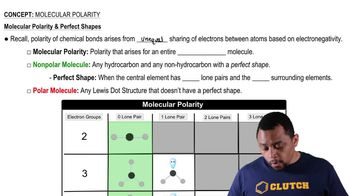
 01:34
01:34