Skip to main content
Introduction to Chemistry
My Course
Learn
Exam Prep
AI Tutor
Study Guides
Flashcards
Explore
Try the app
My Course
Learn
Exam Prep
AI Tutor
Study Guides
Flashcards
Explore
Try the app
Back
Redox Reactions definitions
You can tap to flip the card.
Redox Reaction
You can tap to flip the card.
👆
Redox Reaction
A chemical process involving the transfer of electrons between reactants, resulting in changes to their oxidation numbers.
Track progress
Control buttons has been changed to "navigation" mode.
1/13
Related flashcards
Related practice
Recommended videos
Redox Reactions quiz #1
Redox Reactions
10 Terms
Redox Reactions
16. Oxidation and Reduction
5 problems
Topic
Spontaneous Redox Reactions
16. Oxidation and Reduction
4 problems
Topic
16. Oxidation and Reduction
6 topics
15 problems
Chapter
Guided course
02:17
Redox Reactions Example 1
8254
views
59
rank
Guided course
01:53
Redox Reactions
8998
views
86
rank
Guided course
01:01
Redox Reactions
7804
views
55
rank
Terms in this set (13)
Hide definitions
Redox Reaction
A chemical process involving the transfer of electrons between reactants, resulting in changes to their oxidation numbers.
Oxidation
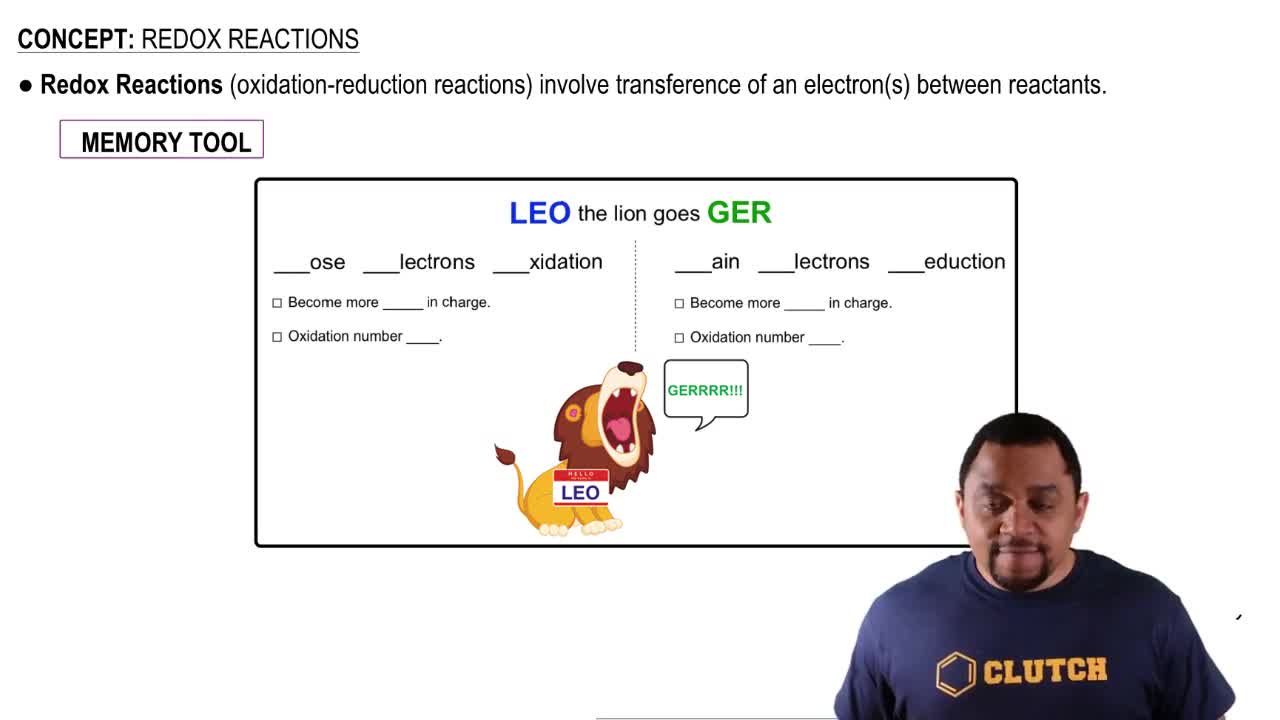
A process where a substance loses electrons, causing its oxidation number to increase and its charge to become more positive.
Reduction
A process where a substance gains electrons, causing its oxidation number to decrease and its charge to become more negative.
Electron Transfer
The movement of negatively charged particles from one reactant to another, central to redox reactions.
Oxidation Number
A value representing the effective charge of an atom, which increases with electron loss and decreases with electron gain.
Oxidizing Agent
A substance that causes another to lose electrons and is itself reduced during a redox reaction.
Reducing Agent
A substance that causes another to gain electrons and is itself oxidized during a redox reaction.
LEO the Lion
A mnemonic device summarizing that losing electrons is oxidation, aiding memory for redox processes.
GER
A mnemonic indicating that gaining electrons is reduction, helping recall the direction of electron flow.
Charge
An electrical property that becomes more positive with electron loss and more negative with electron gain in redox.
Reactant
A starting material in a chemical process that undergoes electron transfer in redox reactions.
Substance
A chemical species whose oxidation number and charge can change during electron transfer.
Agent
A participant in a redox process that facilitates electron loss or gain in another substance.
 BackBack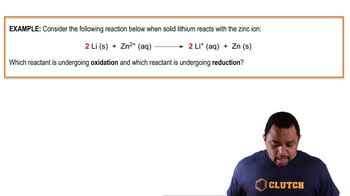
 02:17
02:17