Skip to main content
Introduction to Chemistry
My Course
Learn
Exam Prep
AI Tutor
Study Guides
Flashcards
Explore
Try the app
My Course
Learn
Exam Prep
AI Tutor
Study Guides
Flashcards
Explore
Try the app
Back
Subatomic Particles (Simplified) quiz #2
You can tap to flip the card.
What is the mass of one neutron?
You can tap to flip the card.
👆
What is the mass of one neutron?
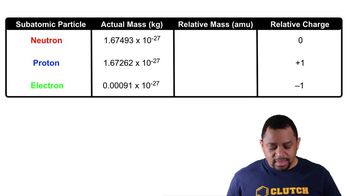
The mass of one neutron is approximately 1.00866 AMU.
Track progress
Control buttons has been changed to "navigation" mode.
1/40
Related flashcards
Related practice
Recommended videos
Subatomic Particles (Simplified) quiz #1
Subatomic Particles (Simplified)
40 Terms
Subatomic Particles (Simplified) quiz #3
Subatomic Particles (Simplified)
40 Terms
Subatomic Particles (Simplified) quiz #4
Subatomic Particles (Simplified)
14 Terms
Subatomic Particles (Simplified)
4. Atoms and Elements
5 problems
Topic
Isotopes
4. Atoms and Elements
5 problems
Topic
4. Atoms and Elements - Part 1 of 2
12 topics
34 problems
Chapter
4. Atoms and Elements - Part 2 of 2
1 topic
3 problems
Chapter
Guided course
01:25
Subatomic Particles (Simplified) Concept 1
5733
views
54
rank
Guided course
02:36
Subatomic Particles (Simplified) Concept 2
4665
views
48
rank
Guided course
03:31
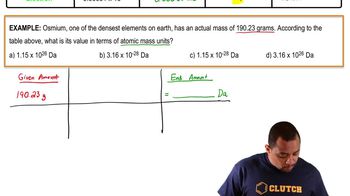
Subatomic Particles (Simplified) Example 1
11739
views
94
rank
Terms in this set (40)
Hide definitions
What is the mass of one neutron?
The mass of one neutron is approximately 1.00866 AMU.
What kind of charge does a proton have?
A proton has a positive charge.
What element has 56 electrons?
A neutral atom with 56 electrons is barium.
What is the positively charged particle of an atom?
The positively charged particle of an atom is the proton.
What parts go in the center of the atom?
Protons and neutrons are located in the center (nucleus) of the atom.
What type of charge does a proton have?
A proton has a positive charge.
What kind of charge does a proton have?
A proton has a positive charge.
What is the smallest subatomic particle in an atom?
The electron is the smallest subatomic particle in an atom.
What charge does a proton carry?
A proton carries a positive charge.
What determines the mass of an atom?
The mass of an atom is determined by the combined mass of its protons and neutrons.
What element has 86 electrons, 125 neutrons, and 82 protons?
An atom with 82 protons is lead.
What element has 17 protons?
The element with 17 protons is chlorine.
What charge does a proton carry?
A proton carries a positive charge.
What particles make up an atom?
An atom is made up of protons, neutrons, and electrons.
What is the mass of a proton?
The mass of a proton is approximately 1.00727 AMU.
What is the location of a proton?
A proton is located in the nucleus of an atom.
What are subatomic particles of an atom?
The subatomic particles of an atom are protons, neutrons, and electrons.
What are the subatomic particles that make up an atom?
Protons, neutrons, and electrons make up an atom.
What are the major subatomic particles of an atom?
The major subatomic particles of an atom are protons, neutrons, and electrons.
How many electrons does a carbon atom have?
A neutral carbon atom has 6 electrons.
How many protons are in a lithium atom?
A lithium atom has 3 protons.
How many protons are in an atom of bismuth?
An atom of bismuth has 83 protons.
How many protons are in one atom of lithium?
One atom of lithium has 3 protons.
How many protons are in a tellurium atom?
A tellurium atom has 52 protons.
How many protons are in an atom of lithium?
An atom of lithium has 3 protons.
How many protons are in a potassium atom?
A potassium atom has 19 protons.
How do you find the mass number of an element?
The mass number is found by adding the number of protons and neutrons in an atom.
Which particles do not affect the stability of the atom?
Electrons do not affect the stability of the atom.
What element has 18 protons?
The element with 18 protons is argon.
What part of an atom has a negative charge?
The electron has a negative charge.
What is the relative mass of an electron?
The relative mass of an electron is 0.00055 AMU.
What is the location of a neutron?
A neutron is located in the nucleus of an atom.
What is the fastest moving particle in an atom?
The electron is the fastest moving particle in an atom.
What is the relative mass of an electron?
The relative mass of an electron is 0.00055 AMU.
What is the mass of a neutron?
The mass of a neutron is approximately 1.00866 AMU.
What do an electron and a neutron have in common?
Both electrons and neutrons are subatomic particles found in atoms.
What is the relative mass of an electron?
The relative mass of an electron is 0.00055 AMU.
What is the relative mass of an electron?
The relative mass of an electron is 0.00055 AMU.
What predicts the element to which an atom belongs?
The number of protons (atomic number) predicts the element to which an atom belongs.
What is the relative mass of a proton?
The relative mass of a proton is 1.00727 AMU.
 BackBack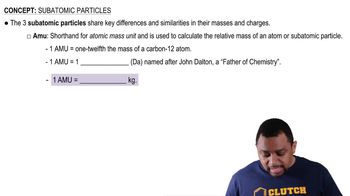
 01:25
01:25