Skip to main content
Introduction to Chemistry
My Course
Learn
Exam Prep
AI Tutor
Study Guides
Flashcards
Explore
Try the app
My Course
Learn
Exam Prep
AI Tutor
Study Guides
Flashcards
Explore
Try the app
Back
The Electron Configuration (Simplified) definitions
You can tap to flip the card.
Periodic Law
You can tap to flip the card.
👆
Periodic Law
Principle stating that element properties repeat periodically when arranged by atomic number, influencing electron arrangements.
Track progress
Control buttons has been changed to "navigation" mode.
1/15
Related flashcards
Related practice
Recommended videos
The Electron Configuration (Simplified) quiz #1
The Electron Configuration (Simplified)
40 Terms
The Electron Configuration (Simplified) quiz #2
The Electron Configuration (Simplified)
40 Terms
The Electron Configuration (Simplified) quiz #3
The Electron Configuration (Simplified)
10 Terms
The Electron Configuration (Simplified)
9. Electrons in Atoms and the Periodic Table
5 problems
Topic
The Electron Configuration: Condensed
9. Electrons in Atoms and the Periodic Table
5 problems
Topic
9. Electrons in Atoms and the Periodic Table - Part 3 of 4
12 topics
36 problems
Chapter
Guided course
01:23
The Electron Configuration (Simplified) Concept 4
4291
views
16
rank
Guided course
02:15
The Electron Configuration (Simplified) Concept 1
12706
views
122
rank
Guided course
00:50
The Electron Configuration (Simplified) Example 1
11351
views
98
rank
Terms in this set (15)
Hide definitions
Periodic Law
Principle stating that element properties repeat periodically when arranged by atomic number, influencing electron arrangements.
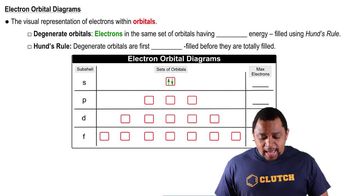
Electron Orbital Diagram
Visual tool showing how electrons occupy orbitals, indicating paired and unpaired electrons and their spins.
Degenerate Orbitals
Set of orbitals within a subshell that share the same energy level, such as the three p orbitals.
Hund's Rule
Guideline stating that electrons fill each degenerate orbital singly before pairing up, maximizing unpaired electrons.
S Sublevel
Subshell containing one orbital, capable of holding up to two electrons with opposite spins.
P Sublevel
Subshell with three orbitals, accommodating up to six electrons, filled according to Hund's rule.
D Sublevel
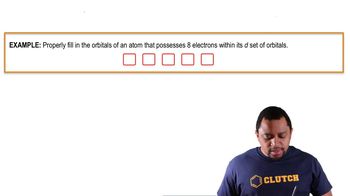
Subshell with five orbitals, allowing a maximum of ten electrons, each orbital filled singly before pairing.
F Sublevel
Subshell containing seven orbitals, holding up to fourteen electrons, filled following Hund's rule.
Aufbau Principle
Concept that electrons occupy the lowest available energy orbitals before filling higher ones.
Aufbau Diagram
Chart or sequence used to determine the order in which orbitals are filled based on increasing energy.
Periodic Table Blocks
Sections of the periodic table (s, p, d, f) corresponding to the type of subshell being filled by electrons.
Paired Electrons
Two electrons occupying the same orbital with opposite spins, resulting in a stable configuration.
Unpaired Electrons
Single electrons in an orbital without a partner, often contributing to magnetic properties.
Electron Configuration
Notation describing the distribution of electrons among orbitals and energy levels for an atom or ion.
Spin
Intrinsic property of electrons, represented as up or down, allowing two electrons to share an orbital.
 BackBack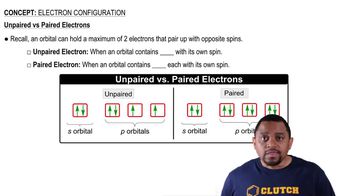
 01:23
01:23