Back

Valence Shell Electron Pair Repulsion Theory (Simplified) definitions

Control buttons has been changed to "navigation" mode.
1/14
  • VSEPR Theory

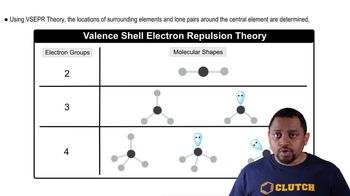
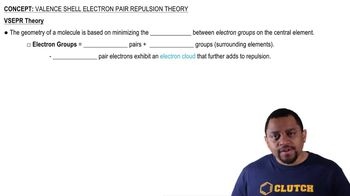
    A model predicting molecular geometry by minimizing repulsion between electron groups on a central atom.
  • Electron Group

    A region of electron density around a central atom, including both lone pairs and bonding groups.
  • Central Element

    The atom in a molecule to which surrounding elements and lone pairs are attached, determining shape.
  • Bonding Group

    A set of electrons shared between the central atom and a surrounding element, forming a bond.
  • Lone Pair

    A pair of valence electrons on the central atom not involved in bonding, increasing electron repulsion.
  • Electron Cloud

    A region where electrons, especially lone pairs, are likely found, contributing to molecular repulsion.
  • Repulsion

    The force that pushes electron groups apart, influencing the spatial arrangement around a central atom.
  • Molecular Shape

    The three-dimensional arrangement of atoms and lone pairs around a central atom in a molecule.
  • Surrounding Element

    An atom bonded to the central atom, contributing to the total number of electron groups.
  • Geometry

    The overall spatial structure formed by electron groups around a central atom.
  • Valence Electron

    An outer-shell electron involved in forming bonds or existing as a lone pair on the central atom.
  • Electron Density

    The probability distribution of electrons in a region, affecting repulsion and molecular structure.
  • Arrangement

    The specific positioning of electron groups around a central atom to minimize repulsion.
  • Shape Prediction

    The process of determining molecular geometry based on the number and type of electron groups.