
Ch. 27 Fluids & Electrolytes
Martini - Fundamentals of Anatomy & Physiology 11th Edition
Martini, Nath, Bartholomew11th EditionFundamentals of Anatomy & PhysiologyISBN: 9780136874089Non è quello che usi tu?Cambia libro di testo
Capitolo 26, Problema 10

Identify four hormones that mediate major physiological adjustments affecting fluid and electrolyte balance. What are the primary effects of each hormone?

Guida verificata passo dopo passo
1
Step 1: Understand that fluid and electrolyte balance in the body is tightly regulated by hormones that influence kidney function, thirst, and cellular ion transport.
Step 2: Identify four key hormones involved in this regulation: Antidiuretic Hormone (ADH), Aldosterone, Atrial Natriuretic Peptide (ANP), and Parathyroid Hormone (PTH).
Step 3: Describe the primary effect of Antidiuretic Hormone (ADH), which increases water reabsorption in the kidneys by making the collecting ducts more permeable to water, thus reducing urine output and conserving body water.
Step 4: Explain Aldosterone's role in promoting sodium reabsorption and potassium excretion in the distal tubules and collecting ducts of the kidneys, which helps retain sodium and water, increasing blood volume and pressure.
Step 5: Outline the effects of Atrial Natriuretic Peptide (ANP), which promotes sodium and water excretion by the kidneys, leading to decreased blood volume and pressure, and Parathyroid Hormone (PTH), which regulates calcium and phosphate balance by increasing calcium reabsorption in the kidneys and mobilizing calcium from bones.

Risposta video verificata per un problema simile:

Questa soluzione video è stata consigliata dai nostri tutor come utile per risolvere questo problema.

Concetti chiave

Ecco i concetti essenziali che devi comprendere per rispondere correttamente alla domanda.

Hormonal Regulation of Fluid and Electrolyte Balance

This concept involves understanding how hormones control the body's water and electrolyte levels by influencing kidney function, thirst, and salt retention. Hormones act as chemical messengers to maintain homeostasis, adjusting fluid volume and ion concentrations in response to physiological needs.
Video consigliato:
Percorso guidato
07:59
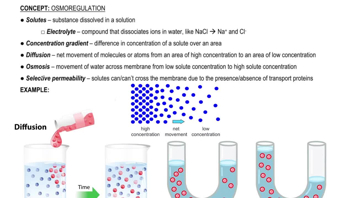
Osmosis and Osmolarity

Antidiuretic Hormone (ADH) and Aldosterone Functions

ADH promotes water reabsorption in the kidneys, reducing urine output to conserve water, while aldosterone increases sodium reabsorption and potassium excretion, helping regulate blood volume and pressure. Both hormones are key in maintaining fluid balance and electrolyte concentrations.
Video consigliato:
13:06
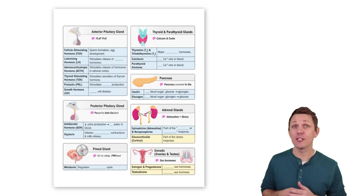
Review of Major Hormones

Role of Atrial Natriuretic Peptide (ANP) and Parathyroid Hormone (PTH)

ANP reduces blood volume by promoting sodium and water excretion, counteracting aldosterone effects. PTH regulates calcium and phosphate balance by increasing calcium reabsorption in kidneys and mobilizing calcium from bones, thus influencing electrolyte homeostasis.
Video consigliato:
4:24
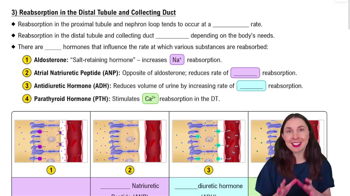
3) Reabsorption in the Distal Tubule and Collecting Duct
Pratica correlata
Domanda del libro di testo

Metabolic alkalosis occurs when:

(a) Bicarbonate ion concentrations become elevated

(b) A severe bicarbonate loss occurs

(c) The kidneys fail to excrete hydrogen ions

(d) Ketone bodies are generated in abnormally large quantities

123
views
Domanda del libro di testo

Drinking a solution hypotonic to the ECF causes the ECF to:

(a) Increase in volume and become hypertonic to the ICF

(b) Decrease in volume and become hypertonic to the ICF

(c) Decrease in volume and become hypotonic to the ICF

(d) Increase in volume and become hypotonic to the ICF

116
views
Domanda del libro di testo

Changes in the pH of body fluids are compensated for by all of the following except:

(a) An increase in urine output

(b) The carbonic acid–bicarbonate buffer system

(c) The phosphate buffer system

(d) Changes in the rate and depth of breathing

(e) Protein buffers

70
views
Domanda del libro di testo

The osmotic concentration of the ECF decreases if an individual gains water without a corresponding:

(a) Gain of electrolytes

(b) Loss of water

(c) Fluid shift from the ECF to the ICF

(d) All of these

50
views
Domanda del libro di testo

When the pH of body fluids begins to decrease, free amino acids and proteins will 

(a) Release a hydrogen from the carboxyl group

(b) Release a hydrogen from the amino group

(c) Release a hydrogen at the carboxyl group

(d) Bind a hydrogen at the amino group

60
views
Domanda del libro di testo

Respiratory acidosis develops when the blood pH is:

(a) Increased due to a decreased blood P𝒸ₒ₂ level

(b) Decreased due to an increased blood P𝒸ₒ₂ level

(c) Increased due to an increased blood P𝒸ₒ₂ level

(d) Decreased due to a decreased blood P𝒸ₒ₂ level

115
views