Ch. 27 Fluids & Electrolytes
Martini - Fundamentals of Anatomy & Physiology 11th Edition
Martini, Nath, Bartholomew11th EditionFundamentals of Anatomy & PhysiologyISBN: 9780136874089Non è quello che usi tu?Cambia libro di testo
Capitolo 26, Problema 8

Respiratory acidosis develops when the blood pH is:
(a) Increased due to a decreased blood P𝒸ₒ₂ level
(b) Decreased due to an increased blood P𝒸ₒ₂ level
(c) Increased due to an increased blood P𝒸ₒ₂ level
(d) Decreased due to a decreased blood P𝒸ₒ₂ level

Guida verificata passo dopo passo
1
Step 1: Understand the definition of respiratory acidosis. Respiratory acidosis occurs when there is an accumulation of carbon dioxide (CO\_2) in the blood, leading to an increase in hydrogen ion concentration and thus a decrease in blood pH.
Step 2: Recall the relationship between CO\_2 and blood pH. CO\_2 reacts with water in the blood to form carbonic acid, which dissociates into hydrogen ions (H\^+) and bicarbonate (HCO\_3\^-). An increase in CO\_2 shifts this equilibrium, increasing H\^+ concentration and lowering pH.
Step 3: Analyze each option in terms of CO\_2 levels and pH changes: (a) Increased pH with decreased CO\_2 is alkalosis, not acidosis; (b) Decreased pH with increased CO\_2 matches respiratory acidosis; (c) Increased pH with increased CO\_2 is contradictory; (d) Decreased pH with decreased CO\_2 is unlikely.
Step 4: Conclude that respiratory acidosis is characterized by a decreased blood pH due to an increased blood CO\_2 level.
Step 5: Therefore, the correct description of respiratory acidosis corresponds to option (b): decreased pH due to increased blood P\_CO\_2.

Risposta video verificata per un problema simile:

Questa soluzione video è stata consigliata dai nostri tutor come utile per risolvere questo problema.

Concetti chiave

Ecco i concetti essenziali che devi comprendere per rispondere correttamente alla domanda.

Respiratory Acidosis

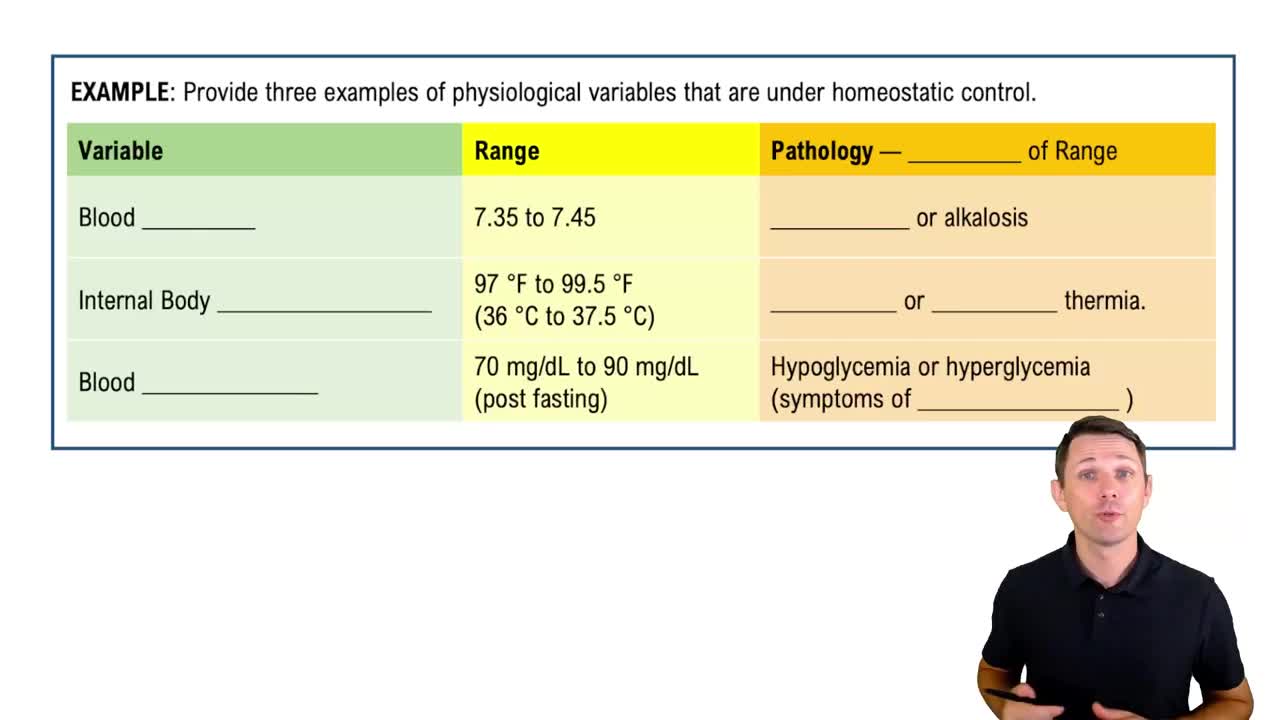
Respiratory acidosis is a condition where the blood becomes more acidic due to impaired lung function, leading to an accumulation of carbon dioxide (CO₂). This excess CO₂ increases hydrogen ion concentration, lowering blood pH below the normal range (7.35-7.45). It typically results from hypoventilation or respiratory diseases.
Video consigliato:
03:46
Homeostasis Example 1

Blood pH and Acid-Base Balance

Blood pH measures the acidity or alkalinity of blood, with normal values around 7.4. A decrease in pH indicates acidosis, while an increase indicates alkalosis. The body maintains pH balance through respiratory and renal mechanisms that regulate CO₂ and bicarbonate levels.
Video consigliato:
Percorso guidato
01:29
Acids and Bases

Partial Pressure of Carbon Dioxide (P𝒸ₒ₂)

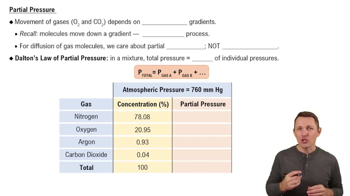
P𝒸ₒ₂ represents the amount of CO₂ gas dissolved in the blood and is a key factor in respiratory regulation of acid-base balance. Elevated P𝒸ₒ₂ (hypercapnia) leads to increased acidity (lower pH), while decreased P𝒸ₒ₂ (hypocapnia) causes alkalinity (higher pH).
Video consigliato:
6:12
Partial Pressure
Pratica correlata
Domanda del libro di testo

The most important factor affecting the pH of body tissues is the concentration of:

(a) Lactic acid

(b) Ketone bodies, 

(c) Metabolic acids

(d) Carbon dioxide

(e) Hydrochloric acid

104
views

Domanda del libro di testo

Metabolic alkalosis occurs when:

(a) Bicarbonate ion concentrations become elevated

(b) A severe bicarbonate loss occurs

(c) The kidneys fail to excrete hydrogen ions

(d) Ketone bodies are generated in abnormally large quantities

123
views
Domanda del libro di testo

Identify four hormones that mediate major physiological adjustments affecting fluid and electrolyte balance. What are the primary effects of each hormone?

57
views
Domanda del libro di testo

Drinking a solution hypotonic to the ECF causes the ECF to:

(a) Increase in volume and become hypertonic to the ICF

(b) Decrease in volume and become hypertonic to the ICF

(c) Decrease in volume and become hypotonic to the ICF

(d) Increase in volume and become hypotonic to the ICF

116
views
Domanda del libro di testo

Changes in the pH of body fluids are compensated for by all of the following except:

(a) An increase in urine output

(b) The carbonic acid–bicarbonate buffer system

(c) The phosphate buffer system

(d) Changes in the rate and depth of breathing

(e) Protein buffers

70
views
Domanda del libro di testo

Calcium homeostasis primarily reflects:

(a) A balance between absorption in the gut and excretion by the kidneys

(b) Careful regulation of the blood calcium level by the kidneys

(c) An interplay between parathyroid hormone and aldosterone, 

(d) An interplay among reserves in the bones, the rate of absorption, and the rate of excretion

(e) Hormonal control of calcium reserves in the bones

136
views