Indietro
 Bruice 8th EditionCh. 15 - Reactions of Carboxylic Acids and Carboxylic Acid Derivatives
Problema 17a
Write a mechanism for each of the following reactions:
a. the uncatalyzed hydrolysis of methyl propionate.
Problema 17b
Write a mechanism for each of the following reactions:
b. the aminolysis of phenyl formate, using methylamine.
Problema 19a
Which ester hydrolyzes more rapidly? a. methyl acetate or phenyl acetate?
Problema 19b
Which ester hydrolyzes more rapidly? b. phenyl acetate or benzyl acetate?
Problema 21c,d
In the mechanism for the acid-catalyzed hydrolysis of an ester,
c. what species is HB+ most likely to be in the hydrolysis reaction?
d. what species is HB+ most likely to be in the reverse reaction?
Problema 22a
Using the mechanism for the acid-catalyzed hydrolysis of an ester as your guide, write the mechanism—showing all the curved arrows—for the acid-catalyzed reaction of acetic acid and methanol to form methyl acetate. Use HB+ and :B to represent the proton-donating and proton-removing species, respectively.
Problema 23a,b
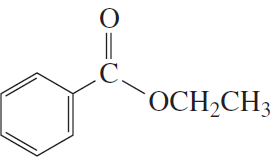
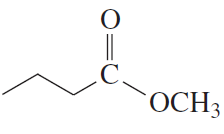
What products are formed from the acid-catalyzed hydrolysis of the following esters?
a.
b.
Problema 24
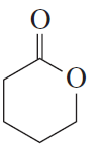
Show the mechanism for the acid-catalyzed formation of 23c starting with the product obtained from its hydrolysis.
Problema 25b
What products are obtained from the following reactions? b. phenyl acetate + excess ethanol + HCl
Problema 26
Write the mechanism for the acid-catalyzed transesterification of ethyl acetate with methanol.
Problema 27
Write the mechanism for the acid-catalyzed reaction of tert-butyl acetate with methanol.
Problema 28b(ii)
b. Explain why the rate of aminolysis of an ester cannot be increased by HO−, or RO−.
Problema 28b(i)
b. Explain why the rate of aminolysis of an ester cannot be increased by H+.
Problema 29
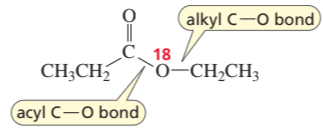
D. N. Kursanov, a Russian chemist, proved that the bond that is broken in the hydroxide-ion-promoted hydrolysis of an ester is the acyl C—O bond, rather than the alkyl C—O bond, by studying the hydrolysis of the following ester under basic conditions:
a. What products contained the 18O label?
b. What product would have contained the 18O label if the alkyl C—O bond had broken?
Problema 31a
Show how each of the following esters could be prepared using a carboxylic acid as one of the starting materials:
a. methyl butyrate (odor of apples)
Problema 32
Propose a mechanism for the following reaction. (Hint: Number the carbons to help you see where they end up in the product.)
Problema 33
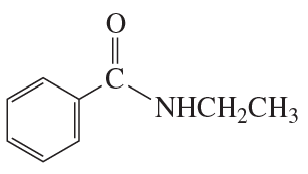
What acyl chloride and amine are required to synthesize the following amides?
a. N-ethylbutanamide
b. N,N-dimethylbenzamide
Problema 34a
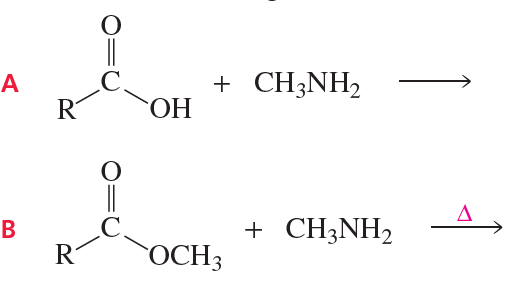
Which of the following reactions lead to the formation of an amide?
Problema 35
Write the mechanism for the acid-catalyzed reaction of an amide with an alcohol to form an ester.
Problema 36
Rank the following amides from greatest reactivity to least reactivity toward acid-catalyzed hydrolysis:
Problema 38a
What alkyl bromide would you use in a Gabriel synthesis to prepare each of the following amines?
a. pentylamine
Problema 38b
What alkyl bromide would you use in a Gabriel synthesis to prepare each of the following amines?
b. isohexylamine
Problema 38c
What alkyl bromide would you use in a Gabriel synthesis to prepare each of the following amines?
c. benzylamine
Problema 38d
What alkyl bromide would you use in a Gabriel synthesis to prepare each of the following amines?
d. cyclohexylamine
Problema 41a,b
Which alkyl halides form the carboxylic acids listed here after reaction with sodium cyanide followed by heating the product in an acidic aqueous solution?
a. butyric acid
b. isovaleric acid
Problema 43a
Propose a mechanism for the reaction of acetic anhydride with water.
Problema 45
We saw that acid anhydrides react with alcohols, water, and amines. In which of these reactions can the tetrahedral intermediate eliminate the carboxylate ion even if it does not lose a proton before the elimination step? Explain.
Problema 46a
Propose a mechanism for the formation of succinic anhydride from succinic acid in the presence of acetic anhydride at neutral pH.
Problema 46b
How does acetic anhydride make it easier to form the anhydride?
Problema 47b
How could you synthesize the following compounds starting with a carboxylic acid?
b.