Indietro
 Bruice 8th EditionCh. 16 - Reactions of Aldehydes and Ketones • More Reactions of Carboxylic Acid Derivatives
Problema 1a,b,c
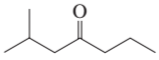
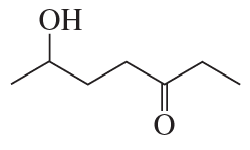
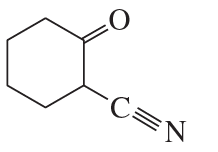
Give two names for each of the following:
a.
b.
c.
Problema 2
Why are numbers not used to designate the position of the functional group in propanone and butanedione?
Problema 3a
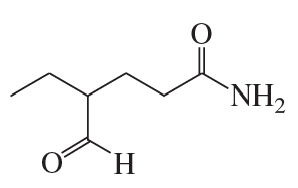
Name the following:
a.
Problema 3b
Name the following:
b.
Problema 3c
Name the following:
c.
Problema 5
What products are formed when the following compounds react with CH3MgBr, followed by the addition of dilute acid? Disregard stereoisomers.
a.
b.
c.
Problema 7a
How many stereoisomers are obtained from the reaction of 2-pentanone with ethylmagnesium bromide followed by the addition of dilute acid?
Problema 9
Which of the following secondary alcohols can be prepared by the reaction of methyl formate with excess Grignard reagent?
Problema 11
Which of the following compounds does not form an alcohol when it reacts with excess Grignard reagent?
Problema 12
Show how the following compounds can be synthesized from cyclohexanol.
a.
b.
c.
Problema 13a(1)
Show how the following compounds can be prepared, using ethyne as one of the starting materials:
1. 1-pentyn-3-ol
Problema 13a(3)
Show how the following compounds can be prepared, using ethyne as one of the starting materials:
3. 2-methyl-3-hexyn-2-ol
Problema 13a(2)
Show how the following compounds can be prepared, using ethyne as one of the starting materials:
2. 1-phenyl-2-butyn-1-ol
Problema 13b
Explain why ethyne should be alkylated before, rather than after, nucleophilic addition.
Problema 14
What is the product of the reaction of an ester with excess acetylide ion followed by the addition of pyridinium chloride?
- Can a cyanohydrin be prepared by treating a ketone with sodium cyanide?
Problema 16
Problema 20a,b
What alcohols are obtained from the reduction of the following compounds with sodium borohydride?
a. 2-methylpropanal
b. cyclohexanone
Problema 20c,d
What alcohols are obtained from the reduction of the following compounds with sodium borohydride?
c. 4-tert-butylcyclohexanone
d. acetophenone
Problema 21a,b
What products are obtained from the reaction of the following compounds with LiAlH4 followed by treatment with dilute acid?
a. ethyl butanoate
b. benzoic acid
Problema 21c,d
What products are obtained from the reaction of the following compounds with LiAlH4 followed by treatment with dilute acid?
c. methyl benzoate
d. pentanoic acid
Problema 22
What amides would you react with LiAlH4 to form the following amines?
a. benzylmethylamine
b. ethylamine
c. diethylamine
d. triethylamine
Problema 23a
How would you make the following compounds from N-benzylbenzamide?
a. dibenzylamine
Problema 23b
How would you make the following compounds from N-benzylbenzamide?
b. benzoic acid
Problema 23c
How would you make the following compounds from N-benzylbenzamide?
c. benzyl alcohol
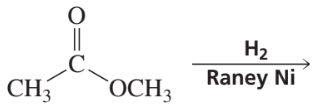
Problema 24
What are the products of the following reactions?
a.
b.
c.
d.
Problema 27
A ketone can be prepared from the reaction of a nitrile with a Grignard reagent. Describe the intermediate formed in this reaction, and show how it can be converted to a ketone.
Problema 28
Why is the pKa value of protonated hydroxylamine (6.0) so much lower than the value of a protonated primary amine such as protonated methylamine (10.7)?
Problema 30a
The pKa of protonated acetone is about –7.5 and the pKa of protonated hydroxylamine is 6.0.
a. In a reaction with hydroxylamine at pH 4.5 (Figure 16.2), what fraction of acetone is present in its acidic, protonated form?
<IMAGE>
Problema 31
Imines can exist as stereoisomers. The isomers are named using the E,Z system of nomenclature (Section 4.2 ). The lone pair has the lowest priority.
<IMAGE>
Draw the structure of each of the following compounds:
a. the (E)-hydrazone of benzaldehyde
b. the (Z)-oxime of propiophenone
Problema 33a,b
What are the products of the following reactions? (A trace amount of acid is present in each case.)
a. cyclopentanone + ethylamine
b. cyclopentanone + diethylamine