Indietro
 Bruice 8th EditionCh. 6 - The Reactions of Alkenes • The Stereochemistry of Addition Reactions
Problema 17b
What is the major product obtained from the reaction of HBr with each of the following?
b.
Problema 18
Which is more highly regioselective: reaction of an alkene with BH3 or with 9-BBN?
Problema 19a
What is the major product obtained from hydroboration–oxidation of the following alkenes?
a. 2-methyl-2-butene
Problema 20
What will be the product of the preceding reaction if HBr is used in place of Br2?
Problema 21a
How does the first step in the reaction of propene with Br2 differ from the first step in the reaction of propene with HBr?
Problema 21b
To understand why Br− adds to a carbon of the bromonium ion rather than to the positively charged bromine, draw the product that would be obtained if Br− did add to bromine.
Problema 22
Why are Na+ and K+ unable to form covalent bonds?
Problema 23a
Each of the following reactions has two nucleophiles that could add to the intermediate formed by the reaction of the alkene with an electrophile. What is the major product of each reaction?
a.
Problema 23b
Each of the following reactions has two nucleophiles that could add to the intermediate formed by the reaction of the alkene with an electrophile. What is the major product of each reaction?
b.
Problema 23c
Each of the following reactions has two nucleophiles that could add to the intermediate formed by the reaction of the alkene with an electrophile. What is the major product of each reaction?
c.
Problema 24
What is the product of the addition of I—Cl to 1-butene? (Hint: Chlorine is more electronegative than iodine [Table 1.3].)
Problema 25a,b
What will be the major product obtained from the reaction of Br2 with 1-butene if the reaction is carried out in
a. dichloromethane?
b. water?
Problema 25c,d
What will be the major product obtained from the reaction of Br2 with 1-butene if the reaction is carried out in
c. ethyl alcohol?
d. methyl alcohol?
Problema 27a,b
Draw structures for the following:
a. 2-propyloxirane
b. cyclohexene oxide
Problema 27c
Draw structures for the following:
c. 2,2,3,3-tetramethyloxirane
Problema 27d
Draw structures for the following:
d. 2,3-epoxy-2-methylpentane
Problema 28a,b
What alkene would you treat with a peroxyacid in order to obtain each of the epoxides in Problem 27?
a. 2-propyloxirane
b. cyclohexene oxide
Problema 28c.d
What alkene would you treat with a peroxyacid in order to obtain each of the epoxides in Problem 27?
c. 2,2,3,3-tetramethyloxirane
d. 2,3-epoxy-2-methylpentane
Problema 29a,b
Identify each of the following reactions as an oxidation reaction, a reduction reaction, or neither.
a.
b.
Problema 30a
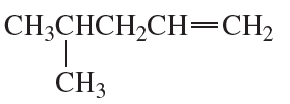
What products are formed when the following compounds react with ozone and then with dimethyl sulfide?
a.
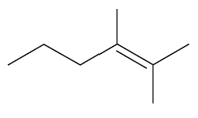
Problema 30b
What products are formed when the following compounds react with ozone and then with dimethyl sulfide?
b.
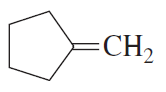
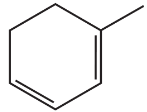
Problema 30c,d
What products are formed when the following compounds react with ozone and then with dimethyl sulfide?
c.
d.
Problema 30e,f
What products are formed when the following compounds react with ozone and then with dimethyl sulfide?
e.
f.
Problema 31a
What alkene would give only a ketone with three carbons as a product of oxidative cleavage?
Problema 31b
What alkenes would give only an aldehyde with four carbons as a product of oxidative cleavage
Problema 32
What aspect of the structure of the alkene does ozonolysis not tell you?
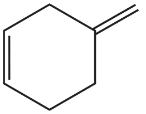
Problema 33b
The following products were obtained from the oxidative cleavage of a diene. What is the structure of the diene?
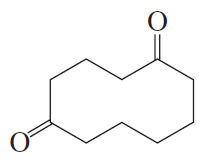
Problema 34a
The following product was obtained from the ozonolysis of an alkene followed by treatment with dimethyl sulfide. What is the structure of the alkene?
a.
Problema 34b
The following product was obtained from the ozonolysis of an alkene followed by treatment with dimethyl sulfide. What is the structure of the alkene?
b.
Problema 34c
The following product was obtained from the ozonolysis of an alkene followed by treatment with dimethyl sulfide. What is the structure of the alkene?
c.