Indietro
Problema 1b(i)
(i) Using bond dissociation energies, calculate ∆H° for the following reactions. [BDE for O―H = 110 kcal /mol.]
(b)
Problema 2
(a) Rank the following carbocations from least stable to most stable. (b) Which would you expect to form first? (c) Which would you expect to react most quickly with a bromide ion (Br⁻) ? [Carbocations, like radicals, are electron deficient.]
Problema 3
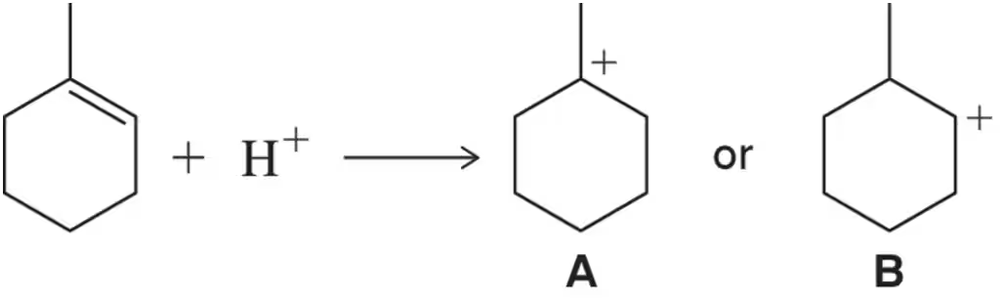
Given that A is more stable than B, draw a reaction coordinate diagram that rationalizes the fact that A forms more quickly than B in the following reaction.
Problema 4
Rationalize the fact that reaction A results in an unequal mixture of products, but reaction B yields an equal mixture of two products.
Problema 5a
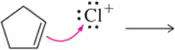
Predict the product that results from the following 'pushed electrons.'
(a)
Problema 5c
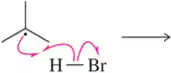
Predict the product that results from the following 'pushed electrons.'
(c)
Problema 5f
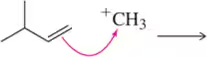
Predict the product that results from the following 'pushed electrons.'
(f)
Problema 5i
Predict the product that results from the following 'pushed electrons.'
(i)
Problema 6a
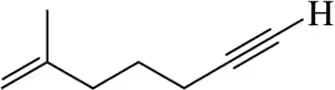
Given the structure, calculate the index of hydrogen deficiency (degrees of unsaturation) of the following molecules.
(a)
Problema 7a
What is the index of hydrogen deficiency for each of the following molecular formulas?
(a) C6H12O6
Problema 7b
What is the index of hydrogen deficiency for each of the following molecular formulas?
(b) C12H11NO3
Problema 7c
What is the index of hydrogen deficiency for each of the following molecular formulas?
(c) C8H14Cl2
Problema 7d
What is the index of hydrogen deficiency for each of the following molecular formulas?
(d) C9H12N2O2
Problema 7e
What is the index of hydrogen deficiency for each of the following molecular formulas?
(e) C6H12O2
Problema 8
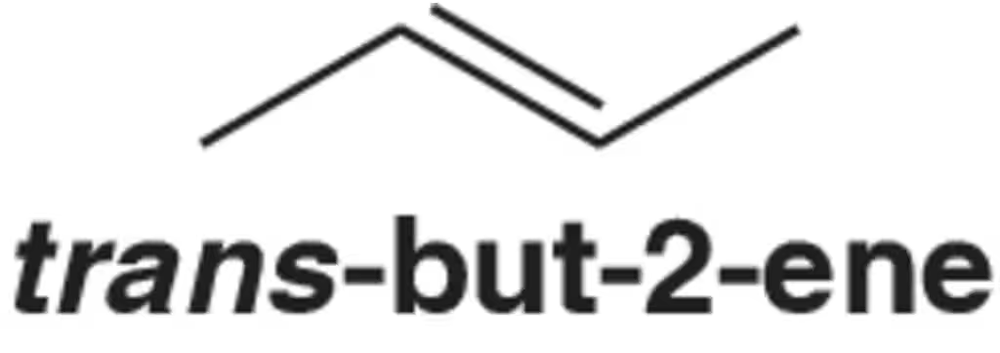
Draw the molecular orbital picture of trans-but-2-ene.
Problema 8.55b
Suggest an alkene to undergo hydroboration–oxidation (1. BH3 2. NaOH, H2O2) to give exclusively the alcohols shown. Pay close attention to the relative (but not absolute) stereochemical outcome.
(b)
Problema 8.39d
Provide the expected product for the reaction of each of the following alkenes with H₂SO₄ and H₂O.
(d)
Problema 9a
Provide the IUPAC names for the following alkenes.
(a)
Problema 10a
Given the following IUPAC names, draw the corresponding structures.
(a) (R)-3-isopropyl-6-methylnon-1-ene
Problema 10c
Given the following IUPAC names, draw the corresponding structures.
(c) (S)-3-fluoropent-1-ene
Problema 11a
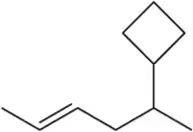
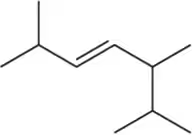
Name the following alkenes, being sure to specify whether they are cis or trans.
(a)
Problema 11c
Name the following alkenes, being sure to specify whether they are cis or trans.
(c)
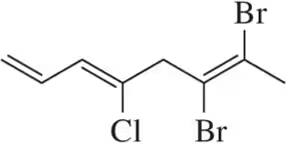
Problema 12a
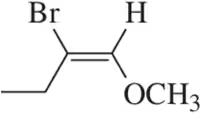
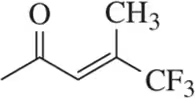
Which of the following alkenes are E and which are Z?
(a)
Problema 12b
Which of the following alkenes are E and which are Z?
(b)
Problema 12c
Which of the following alkenes are E and which are Z?
(c)
Problema 13a
Given the name, draw the structure of the following alkenes.
(a) (E)-4-ethyl-5-methyloct-3-ene
Problema 13b
Given the name, draw the structure of the following alkenes.
(b) ((Z)-1-cyclohexyl-2-methylhept-2-ene
Problema 13c
Given the name, draw the structure of the following alkenes.
(c) (Z)-3-isopropylhept-3-ene
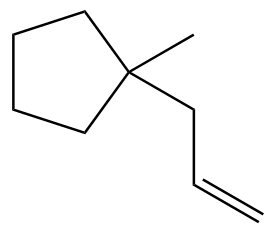
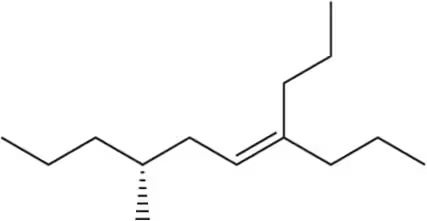
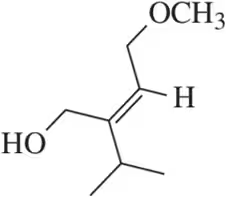
Problema 15b
Name the following alkenes.
(b)
Problema 16
How many stereoisomers are possible (a) for 4-methylnona-2,7-diene? (b) For 6-chloronona-2,4,7-triene?