Indietro
Problema 31b
Like other strong nucleophiles, triphenylphosphine attacks and opens epoxides. The initial product (a betaine) quickly cyclizes to an oxaphosphetane that collapses to an alkene and triphenylphosphine oxide.
(b) Show how this sequence might be used to convert cis-cyclooctene to trans-cyclooctene.
Problema 32
(a) Outline the syntheses indicated in Solved Problem 18-2, beginning with aldehydes and alkyl halides.
(b) Both of these syntheses of 1-phenylbuta-1,3-diene form the central double bond. Show how you would synthesize this target molecule by forming the terminal double bond.
Problema 33a,b
Show how Wittig reactions might be used to synthesize the following compounds. In each case, start with an alkyl halide and a ketone or an aldehyde.
(a) Ph–CH=C(CH3)2
(b) Ph–C(CH3)=CH2
Problema 33c,d
Show how Wittig reactions might be used to synthesize the following compounds. In each case, start with an alkyl halide and a ketone or an aldehyde.
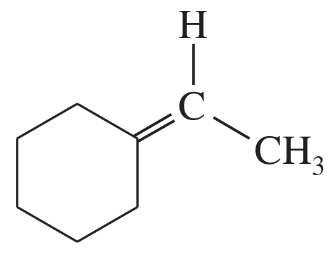
(c) Ph–CH=CH–CH=CH–Ph
(d)
Problema 34a
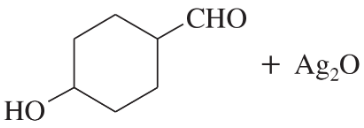
Predict the major products of the following reactions.
(a)
Problema 34b
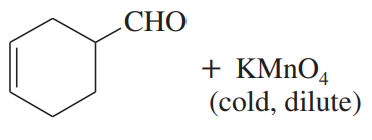
Predict the major products of the following reactions.
(b)
Problema 34c
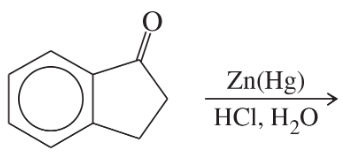
Predict the major products of the following reactions.
(c)
Problema 34d
Predict the major products of the following reactions.
(d)
Problema 35a
Propose a mechanism for both parts of the Wolff–Kishner reduction of cyclohexanone: the formation of the hydrazone, and then the base-catalyzed reduction with evolution of nitrogen gas.
Problema 35b
Propose a mechanism for both parts of the Wolff–Kishner reduction of cyclohexanone: the formation of the hydrazone, and then the base-catalyzed reduction with evolution of nitrogen gas.
Problema 36a
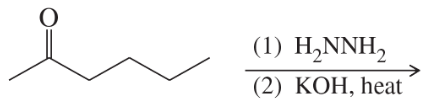
Predict the major products of the following reactions:
(a)
Problema 36b
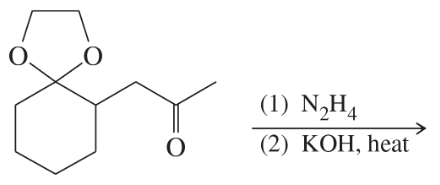
Predict the major products of the following reactions:
(b)
Problema 36c
Predict the major products of the following reactions:
(c)
Problema 36d
Predict the major products of the following reactions:
(d)
Problema 37a
Draw structures of the following derivatives.
(a) the 2,4-dinitrophenylhydrazone of benzaldehyde
Problema 37b
Draw structures of the following derivatives.
(b) the semicarbazone of cyclobutanone
Problema 37c
Draw structures of the following derivatives.
(c) cyclopropanone oxime
Problema 37d
Draw structures of the following derivatives.
(d) the ethylene acetal of hexan-3-one
Problema 37e
Draw structures of the following derivatives.
(e) acetaldehyde dimethyl acetal
Problema 37f
Draw structures of the following derivatives.
(f) the methyl hemiacetal of formaldehyde
Problema 37g
Draw structures of the following derivatives.
(g) the (E) isomer of the ethyl imine of propiophenone
Problema 37h
Draw structures of the following derivatives.
(h) the hemiacetal form of 5-hydroxypentanal
Problema 38b
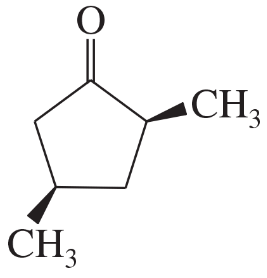
Name the following ketones and aldehydes. When possible, give both a common name and an IUPAC name.
(b) CH3(CH2)2CO(CH2)2CH3
Problema 38c
Name the following ketones and aldehydes. When possible, give both a common name and an IUPAC name.
(c) CH3(CH2)5CHO
Problema 38d
Name the following ketones and aldehydes. When possible, give both a common name and an IUPAC name.
(d) PhCOPh
Problema 38g
Name the following ketones and aldehydes. When possible, give both a common name and an IUPAC name.
(g) CH3CH2CHBrCH2CH(CH3)CHO
Problema 38h
Name the following ketones and aldehydes. When possible, give both a common name and an IUPAC name.
(h) Ph–CH=CH–CHO
Problema 38j
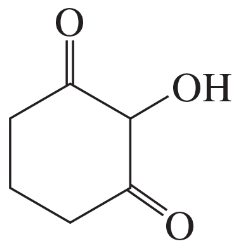
Name the following ketones and aldehydes. When possible, give both a common name and an IUPAC name.
(j)
Problema 38k
Name the following ketones and aldehydes. When possible, give both a common name and an IUPAC name.
(k)
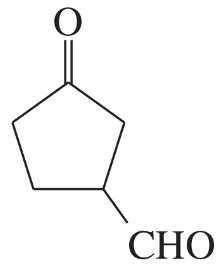
Problema 38l
Name the following ketones and aldehydes. When possible, give both a common name and an IUPAC name.
(l)