Indietro
Problema 23c
Predict the products from the reactions of the following amines with sodium nitrite in dilute HCl.
(c) piperidine
Problema 23d
Predict the products from the reactions of the following amines with sodium nitrite in dilute HCl.
(d) aniline
Problema 24
Propose a mechanism for the synthesis of methyl orange.
Problema 25a,b,c
Give the expected products of lithium aluminum hydride reduction of the following compounds (followed by hydrolysis).
(a) butyronitrile
(b) N-cyclohexylacetamide
(c) ε-caprolactam
Problema 25a,b
Show how you would convert aniline to the following compounds.
(a) fluorobenzene
(b) chlorobenzene
Problema 25c
Show how you would convert aniline to the following compounds.
(c) 1,3,5-trimethylbenzene
Problema 25d,e
Show how you would convert aniline to the following compounds.
(d) bromobenzene
(e) iodobenzene
Problema 25f
Show how you would convert aniline to the following compounds.
(f) benzonitrile
Problema 25g
Show how you would convert aniline to the following compounds.
(g) phenol
Problema 26a,b,c
Show how to synthesize the following amines from the indicated starting materials by reductive amination.
(a) benzylmethylamine from benzaldehyde
(b) N-benzylpiperidine from piperidine
(c) N-cyclohexylaniline from cyclohexanone
Problema 26e
Show how to synthesize the following amines from the indicated starting materials by reductive amination.
(e)
Problema 27
Show how to synthesize the following amines from the indicated starting materials by acylation–reduction.
(a) N-butylpiperidine from piperidine
(b) N-benzylaniline from aniline
Problema 28
Addition of one equivalent of ammonia to 1-bromoheptane gives a mixture of heptan-1-amine, some dialkylamine, some trialkylamine, and even some tetraalkylammonium bromide.
(a) Give a mechanism to show how this reaction takes place, as far as the dialkylamine.
(b) How would you modify the procedure to get an acceptable yield of heptan-1-amine?
Problema 29a,b,c
Show how Gabriel syntheses are used to prepare the following amines.
(a) benzylamine
(b) hexan-1-amine
(c) γ-aminobutyric acid
Problema 30a
Show how you would accomplish the following synthetic conversions.
(a) benzyl bromide → benzylamine
Problema 30b
Show how you would accomplish the following synthetic conversions.
(b) 1-bromo-2-phenylethane → 3-phenylpropan-1-amine
Problema 30c
Show how you would accomplish the following synthetic conversions.
(c) pentanoic acid → pentan-1-amine
Problema 30d
Show how you would accomplish the following synthetic conversions.
(d) pentanoic acid → hexan-1-amine
Problema 30e
Show how you would accomplish the following synthetic conversions.
(e) (R)-2-bromobutane → (S)-butan-2-amine
Problema 30f
Show how you would accomplish the following synthetic conversions.
(f) (R)-2-bromobutane → (S)-2-methylbutan-1-amine
Problema 31a
Show how to prepare the following aromatic amines by aromatic nitration, followed by reduction. You may use benzene and toluene as your aromatic starting materials.
(a) aniline
Problema 31d
Show how to prepare the following aromatic amines by aromatic nitration, followed by reduction. You may use benzene and toluene as your aromatic starting materials.
(d) m-aminobenzoic acid
Problema 32a,b,c
For each compound,
(1) classify the nitrogen-containing functional groups.
(2) provide an acceptable name.
(a)
(b)
(c)
Problema 32g,h
For each compound,
(1) classify the nitrogen-containing functional groups.
(2) provide an acceptable name.
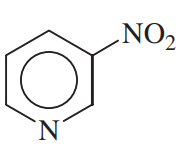
(g)
(h)
Problema 33a
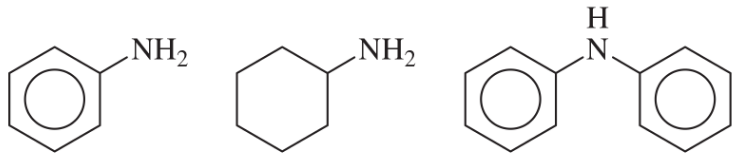
Rank the amines in each set in order of increasing basicity.
(a)
Problema 33c
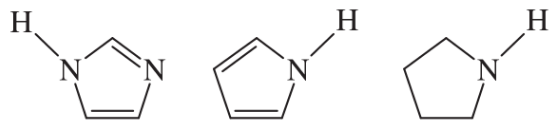
Rank the amines in each set in order of increasing basicity.
(c)
Problema 33d
Rank the amines in each set in order of increasing basicity.
(d)
Problema 33e
Rank the amines in each set in order of increasing basicity.
(e)
Problema 34a,b
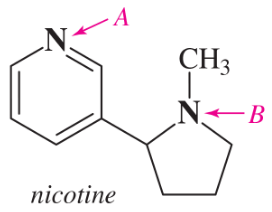
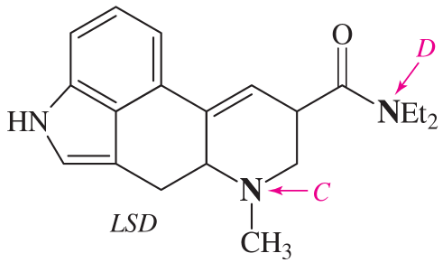
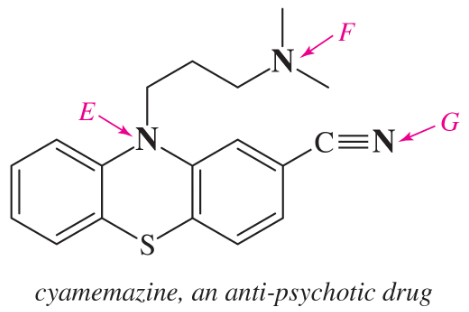
Within each structure, rank the indicated nitrogens by increasing basicity.
(a)
(b)
Problema 34c
Within each structure, rank the indicated nitrogens by increasing basicity.
(c)