Ch. 10 Muscle Tissue
Martini - Fundamentals of Anatomy & Physiology 11th Edition
Martini, Nath, Bartholomew11th EditionFundamentals of Anatomy & PhysiologyISBN: 9780136874089당신이 사용하는 게 아니라요?교과서 변경
10장, 문제 24

How does cardiac muscle tissue contract without neural stimulation?

검증된 단계별 안내
1
Understand that cardiac muscle tissue is unique because it can contract without direct neural stimulation due to its intrinsic properties.
Recognize that cardiac muscle cells have specialized pacemaker cells located in the sinoatrial (SA) node, which generate spontaneous electrical impulses.
These pacemaker cells undergo rhythmic depolarization due to the movement of ions (such as Na\^+, K\^+, and Ca\^2\^+) across their membranes, creating action potentials without external stimuli.
The action potentials from the SA node spread through the cardiac muscle via gap junctions in intercalated discs, allowing coordinated contraction of the heart muscle.
Thus, the heart's ability to contract autonomously is due to the pacemaker cells' automaticity and the electrical coupling between cardiac muscle cells, not requiring neural input to initiate contraction.

비슷한 문제에 대한 검증된 영상 답변:

이 영상 해법은 위 문제에 도움이 된다고 튜터들이 추천한 것입니다.
영상 길이:
3m
도움이 되었나요?

주요 개념

질문에 올바르게 답하기 위해 반드시 이해해야 하는 핵심 개념들은 다음과 같습니다.

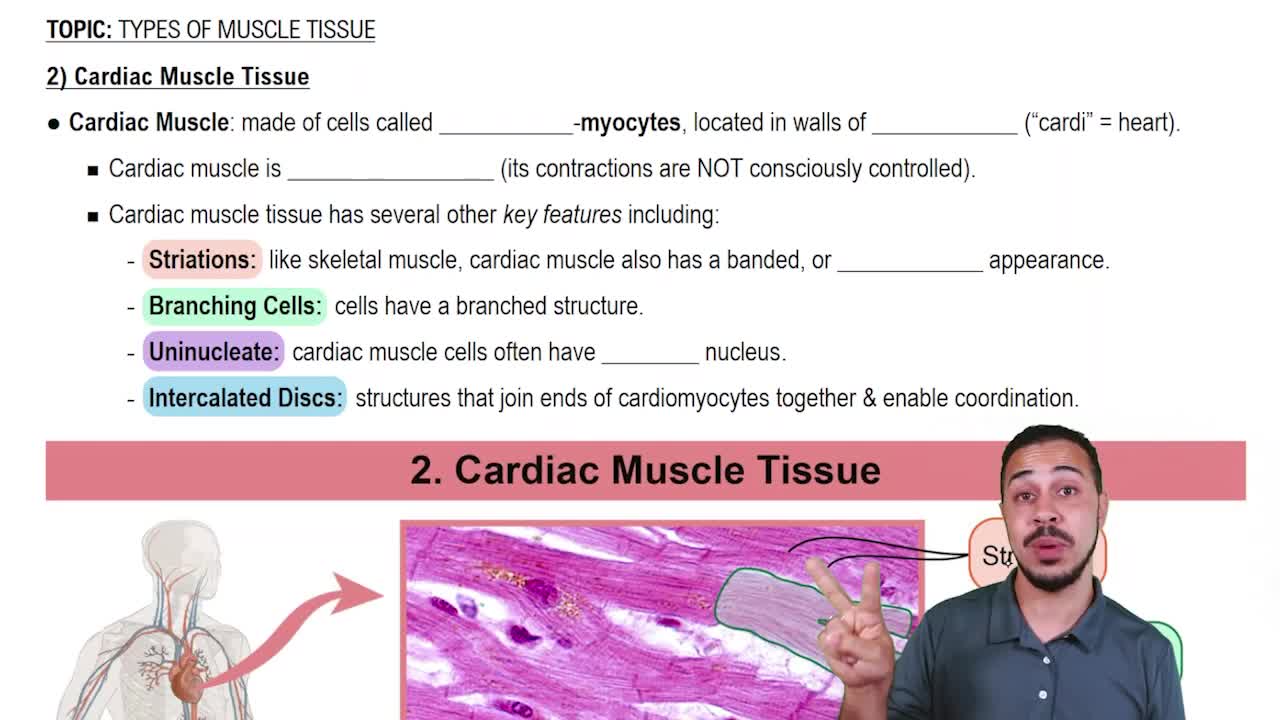
Cardiac Muscle Tissue Structure

Cardiac muscle tissue is composed of specialized muscle cells called cardiomyocytes, which are interconnected by intercalated discs. These discs contain gap junctions that allow electrical impulses to pass directly between cells, enabling coordinated contraction without external neural input.
추천 영상:
가이드 코스
06:00
Cardiac Muscle Tissue

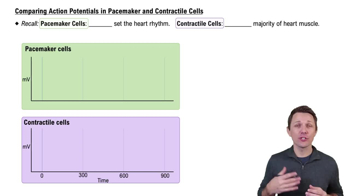
Autorhythmicity and Pacemaker Cells

Certain cardiac cells, known as pacemaker cells, have the unique ability to generate spontaneous electrical impulses. This autorhythmicity allows the heart to initiate contractions independently of the nervous system, maintaining a regular heartbeat through intrinsic electrical activity.
추천 영상:
가이드 코스
6:36
Comparing Action Potentials in Pacemaker and Contractile Cells

Role of the Sinoatrial (SA) Node

The SA node, located in the right atrium, acts as the heart's natural pacemaker by producing rhythmic electrical signals. These signals spread through the heart muscle, triggering contraction in a coordinated manner without requiring neural stimulation.
추천 영상:
5:05
Introduction to Lymph Nodes