뒤로
뒤로
문제 1a
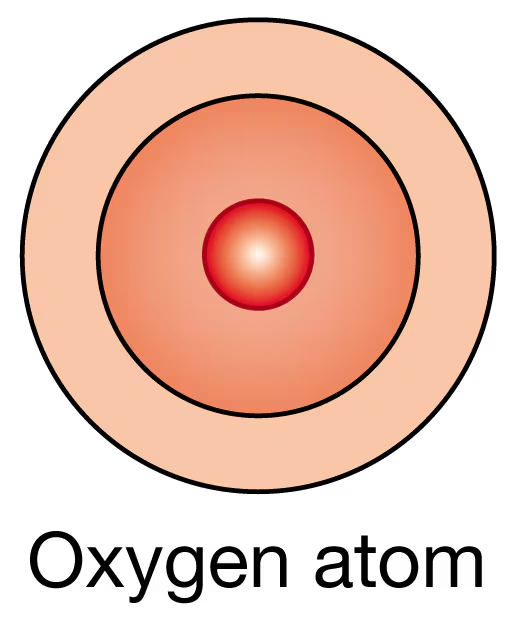
An oxygen atom has eight protons.
(a) Sketch in the arrangement of electrons around the nucleus of the oxygen atom in the following diagram.
문제 1b
An oxygen atom has eight protons.
(b) How many more electrons will it take to fill the outermost energy level?
문제 2
What is the following type of decomposition reaction called?
ABCD + H₂O → ABCH + DOH
문제 3
The subatomic particle with the least mass
(a) Carries a negative charge
(b) Carries a positive charge
(c) Plays no part in the atom's chemical reactions
(d) Is found only in the nucleus
문제 4
Isotopes of an element differ from each other in the number of
(a) Protons in the nucleus
(b) Neutrons in the nucleus
(c) Electrons in the outer shells
(d) a, b, and c are all correct
문제 5
The number and arrangement of electrons in an atom's outer energy level (valence shell) determine the atom's
(a) Atomic weight
(b) Atomic number
(c) Molecular weight
(d) Chemical properties
문제 6
All organic compounds in the human body contain all of the following elements except
(a) Hydrogen
(b) Oxygen
(c) Carbon
(d) Calcium
(e) Both a and d
문제 7
A substance containing atoms of different elements that are bonded together is called a(n)
(a) Molecule
(b) Compound
(c) Mixture
(d) Isotope
(e) Solution
문제 8
All the chemical reactions that occur in the human body are collectively referred to as
(a) Anabolism
(b) Catabolism
(c) Metabolism
(d) Homeostasis
문제 9
Which of the following chemical equations illustrates a typical decomposition reaction?
a. A + B → AB
b. AB + CD → AD + CB
c. 2A₂+ B₂ → 2A₂B
d. AB → A + B
문제 10
The speed, or rate, of a chemical reaction is influenced by
(a) The presence of catalysts
(b) The temperature
(c) The concentration of the reactants
(d) a, b, and c are all correct
문제 11
A pH of 7.8 in the human body typifies a condition referred to as
(a) Acidosis
(b) Alkalosis
(c) Dehydration
(d) Homeostasis
문제 12
A(n)__is a solute that dissociates to release hydrogen ions, and a(n)___is a solute that removes hydrogen ions from solution.
(a) base, acid
(b) salt, base
(c) acid, salt
(d) acid, base
문제 13
Special catalytic molecules called___speed up chemical reactions in the human body.
(a) enzymes
(b) cytozymes
(c) cofactors
(d) activators
(e) cytochromes
문제 14
Which of the following is not a function of a protein?
(a) Support
(b) Transport
(c) Metabolic regulation
(d) Storage of genetic information
(e) Movement
문제 15
Complementary base pairing in DNA includes the pairs
(a) Adenine–uracil and cytosine–guanine
(b) Adenine–thymine and cytosine–guanine
(c) Adenine–guanine and cytosine–thymine
(d) Guanine–uracil and cytosine–thymine
문제 16
What are the three subatomic particles in atoms?
문제 17
What four major classes of organic compounds (polymers) are found in the body?
문제 18
List three important functions of triglycerides (neutral fats) in the body.
문제 19
List seven major functions performed by proteins.
문제 20a
a. What three basic components make up a nucleotide of DNA?
문제 20b
b. What three basic components make up a nucleotide of RNA?
문제 21
What three components are required to create the high-energy compound ATP?
문제 22
If a polypeptide contains 10 peptide bonds, how many amino acids does it contain?
(a) 9
(b) 10
(c) 11
(d) 12
문제 23
A dehydration synthesis reaction between glycerol and a single fatty acid would yield a(n)
(a) Micelle
(b) Omega-3 fatty acid
(c) Triglyceride
(d) Monoglyceride
(e) Diglyceride
문제 24
Explain how enzymes function in chemical reactions.
문제 25
What is a salt? How does a salt differ from an acid or a base?
문제 26
Explain the differences among nonpolar covalent bonds, polar covalent bonds, and ionic bonds.
문제 27
In an exergonic reaction,
(a) Large molecules are broken down into smaller ones.
(b) Small molecules are assembled into larger ones.
(c) Molecules are rearranged to form new molecules.
(d) Molecules move from reactants to products and back.
(e) Energy is released during the reaction.
문제 28
The hydrogen bonding that occurs in water is responsible for all of the following except
(a) The high boiling point of water
(b) The low freezing point of water
(c) The ability of water to dissolve nonpolar substances
(d) The ability of water to dissolve inorganic salts
(e) The surface tension of water