뒤로
뒤로
문제 1
The chorionic villi
(a) Form the umbilical cord
(b) Form the umbilical vein
(c) Form the umbilical arteries
(d) Increase the surface area available for exchange between the placenta and maternal blood
(e) Form the portion of the placenta called the capsular decidua
문제 2
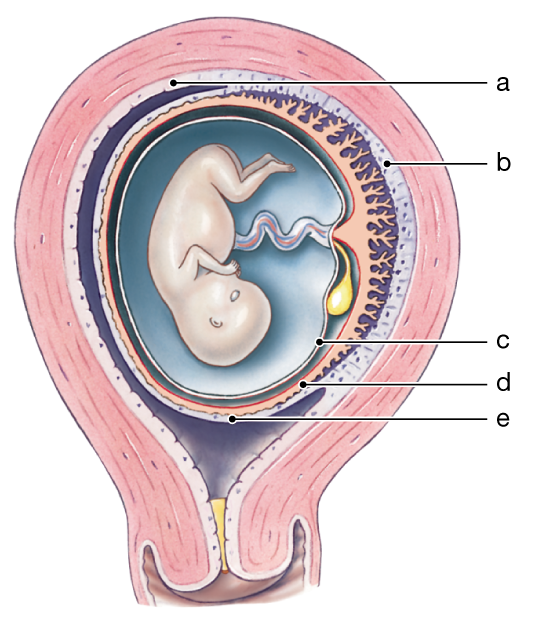
Identify the two extra-embryonic membranes and the three different regions of the endometrium at week 10 of development in the following diagram.
a. ___
b. ___
c. ___
d. ___
e. ___
문제 4
Recessive X-linked traits
(a) Are passed from fathers to their sons
(b) Are more likely to be expressed in males
(c) Always affect some aspect of the reproductive system
(d) Are never expressed in females
(e) Cannot be passed from mothers to daughters
문제 5
The stage of development that follows cleavage is the
(a) Blastocyst
(b) Morula
(c) Trophoblast
(d) Blastocoele
문제 6
The pre-embryo develops into a multicellular complex known as a
(a) Blastocyst
(b) Trophoblast
(c) Lacuna
(d) Blastomere
문제 7
The structure(s) that allow(s) active and passive exchange between the fetal and maternal bloodstreams is/are the
(a) Yolk stalk
(b) Chorionic villi
(c) Umbilical veins
(d) Umbilical arteries
문제 8
If an allele must be present on both the maternal and paternal chromosomes to affect the phenotype, the allele is said to be
(a) Dominant
(b) Recessive
(c) Complementary
(d) Heterozygous
문제 10a
What are the four extra-embryonic membranes?
문제 10b
From which germ layers do these membranes form, and what are their functions?
문제 12
List the factors involved in initiating labor contractions.
문제 14
What hormonal events are responsible for puberty? Which life stage does puberty initiate?
문제 15
A normally pigmented woman whose father was an albino marries a normally pigmented man whose mother was an albino. What is the probability that they would have an albino child?
(a) 50 percent
(b) 25 percent
(c) 12.5 percent
(d) 6.25 percent
(e) 100 percent
문제 17
Problems involving the formation of the chorion would affect
(a) The embryo’s ability to produce blood cells
(b) The formation of limbs
(c) The embryo’s ability to derive nutrition from the mother
(d) Lung formation
(e) The urinary system
문제 18
After implantation, how does the developing embryo obtain nutrients? What structures and processes are involved?
문제 19
Name the primary placental hormones and their functions.
문제 23a
Distinguish between the following paired terms:
(a) genotype and phenotype,
문제 23b
Distinguish between the following paired terms:
(b) heterozygous and homozygous,
문제 23c
Distinguish between the following paired terms:
(c) simple inheritance and polygenic inheritance.
문제 24a
Indicate the type of inheritance involved in each of the following situations.
(a) Children who exhibit the trait have at least one parent who also exhibits it.
문제 24b
Indicate the type of inheritance involved in each of the following situations.
(b) Children exhibit the trait even though neither parent does.
문제 24c
Indicate the type of inheritance involved in each of the following situations.
(c) The trait is expressed more commonly in sons than in daughters.
문제 24d
Indicate the type of inheritance involved in each of the following situations.
(d) The trait is expressed equally in daughters and sons.
문제 25
Hemophilia A, a condition in which blood does not clot properly, is a recessive trait located on the X chromosome (Xʰ). Suppose that a woman who is heterozygous for this trait (XXʰ) has children with a normal male (XY). What is the probability that the couple will have daughters with hemophilia? What is the probability that the couple will have sons with hemophilia?