뒤로
뒤로
문제 1
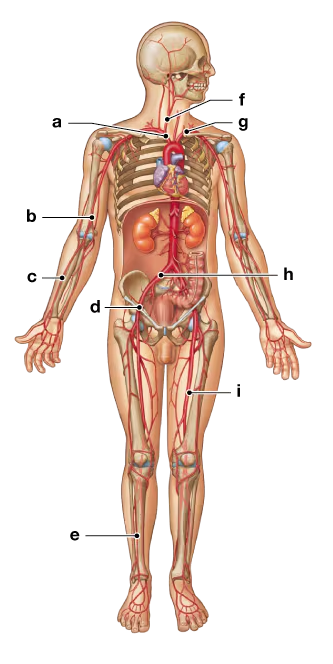
Identify the major arteries in the following diagram.
a. ___
b. ___
c. ___
d. ___
e. ___
f. ___
g. ___
h. ___
i. ___
문제 2
The blood vessels that play the most important role in regulating blood pressure and blood flow to a tissue are the:
(a) Arteries
(b) Arterioles
(c) Veins
(d) Venules
(e) Capillaries
문제 3
Cardiovascular function is regulated by all of the following except:
(a) Local factors
(b) Neural factors
(c) Endocrine factors
(d) Venous return
(e) Conscious control
문제 4
Baroreceptors that function in the regulation of blood pressure are located in the:
(a) Left ventricle
(b) Brainstem
(c) Carotid sinus
(d) Common iliac artery
(e) Pulmonary trunk
문제 6
Large molecules such as peptides and proteins move into and out of the bloodstream by way of:
(a) Continuous capillaries
(b) Fenestrated capillaries
(c) Thoroughfare channels
(d) Venules
문제 7
The local control of blood flow due to the action of precapillary sphincters is:
(a) Vasomotion
(b) Autoregulation
(c) Selective resistance
(d) Turbulence
문제 8
Blood is transported through the venous system by means of:
(a) Skeletal muscle contractions
(b) Decreasing blood pressure
(c) The respiratory pump
(d) A and C
문제 9
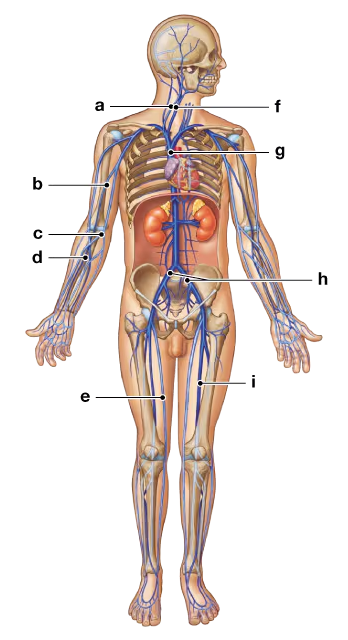
Identify the major veins in the following diagram.
a. ___
b. ___
c. ___
d. ___
e. ___
f. ___
g. ___
h. ___
i. ___
문제 10
The most important factor in vascular resistance is:
(a) The viscosity of the blood
(b) The diameter of the lumen of blood vessels
(c) Turbulence due to irregular surfaces of blood vessels
(d) The length of the blood vessels
문제 11
Net hydrostatic pressure forces water ____ a capillary; net osmotic pressure reabsorbs water _____ a capillary.
(a) into, out of
(b) out of, into
(c) out of, out of
(d) into, into
문제 12
The two arteries formed by the division of the brachiocephalic trunk are the:
(a) Aorta and internal carotid
(b) Axillary and brachial
(c) External and internal carotid
(d) Common carotid and subclavian
문제 13
The unpaired arteries supplying blood to the visceral organs include:
(a) The adrenal, renal, and lumbar arteries
(b) The iliac, gonadal, and femoral arteries
(c) The celiac and superior and inferior mesenteric arteries
(d) All of these
문제 14
The paired arteries supplying blood to the body wall and other structures outside the abdominopelvic cavity include the:
a) Left gastric, hepatic, splenic, and phrenic arteries
(b) Adrenal, colic, lumbar, and gonadal arteries
(c) Iliac, femoral, and lumbar arteries
(d) Celiac, left gastric, and superior and inferior mesenteric arteries
문제 15
The vein that drains the dural sinuses of the brain is the
(a) Cephalic vein
(b) Great saphenous vein
(c) Internal jugular vein
(d) Superior vena cava
문제 16
The vein that collects most of the venous blood inferior to the diaphragm is the
(a) Superior vena cava
(b) Great saphenous vein
(c) Inferior vena cava
(d) Azygos vein
문제 17
What are the primary forces that cause fluid to move?
(a) Out of a capillary at its arterial end and into the interstitial fluid
(b) Into a capillary at its venous end from the interstitial fluid?
문제 18
What cardiovascular changes occur at birth?
문제 19
A major difference between the arterial and venous systems is that
(a) Arteries are usually more superficial than veins.
(b) In the limbs there is dual venous drainage.
(c) Veins are usually less branched compared to arteries.
(d) Veins exhibit a much more orderly pattern of branching in the limbs.
(e) Veins are not found in the abdominal cavity.
문제 20
Which of the following conditions would have the greatest effect on peripheral resistance?
(a) Doubling the length of a vessel
(b) Doubling the diameter of a vessel
(c) Doubling the viscosity of the blood
(d) Doubling the turbulence of the blood
(e) Doubling the number of white cells in the blood
문제 21
Which of the following is greater?
(a) The osmotic pressure of the interstitial fluid during inflammation
(b) The osmotic pressure of the interstitial fluid during normal conditions
(c) Neither is greater
문제 22
Relate the anatomical differences between arteries and veins to their functions.
문제 23
Why do capillaries permit the diffusion of materials, whereas arteries and veins do not?
문제 24
How is blood pressure maintained in veins to counter the force of gravity?
문제 25
How do pressure and resistance affect cardiac output and peripheral blood flow?
문제 26
Why is blood flow to the brain relatively continuous and constant?
문제 27
Compare the effects of the cardioacceleratory and cardioinhibitory centers on cardiac output and blood pressure.
문제 28
Bob is sitting outside on a warm day and is sweating profusely. Mary wants to practice taking blood pressures, and he agrees to play the patient. Mary finds that Bob's blood pressure is elevated, even though he is resting and has lost fluid from sweating. (She reasons that fluid loss should lower blood volume and, thus, blood pressure.) Why is Bob's blood pressure high instead of low?
문제 29
People with allergies commonly take antihistamines with decongestants to relieve their symptoms. The container warns that individuals who are being treated for high blood pressure should not take the medication. Why not?
문제 30
Jolene awakens suddenly to the sound of her alarm clock. Realizing that she is late for class, she jumps to her feet, feels light-headed, and falls back on her bed. What probably caused this reaction? Why doesn't this happen all the time?