Ch. 13 The Spinal Cord, Spinal Nerves, and Spinal Reflexes
Martini - Fundamentals of Anatomy & Physiology 11th Edition
Martini, Nath, Bartholomew11th EditionFundamentals of Anatomy & PhysiologyISBN: 9780136874089당신이 사용하는 게 아니라요?교과서 변경
13장, 문제 30

Bowel and urinary bladder control involve spinal reflex arcs that are located in the sacral region of the spinal cord. In both instances, two sphincter muscles—an inner sphincter of smooth muscle and an outer sphincter of skeletal muscle—control the passage of wastes (feces and urine) out of the body. How would a transection of the spinal cord at the L1 segment level affect an individual's bowel and bladder control?

검증된 단계별 안내
1
Step 1: Understand the anatomy involved. The bowel and urinary bladder control rely on spinal reflex arcs located in the sacral region of the spinal cord, specifically controlling the inner sphincter (smooth muscle) and outer sphincter (skeletal muscle).
Step 2: Identify the location of the spinal cord transection. The injury is at the L\_1 segment, which is above the sacral region where the reflex arcs for bowel and bladder control reside.
Step 3: Analyze the effect of the transection on neural pathways. Since the transection is above the sacral reflex centers, communication between the brain and these reflex arcs will be disrupted, but the reflex arcs themselves remain intact.
Step 4: Predict the functional outcome. Without brain control, voluntary control of the outer sphincter (skeletal muscle) is lost, but reflexive control of the inner sphincter (smooth muscle) may still occur, leading to reflexive emptying without voluntary control.
Step 5: Summarize the clinical implication. The individual would likely experience loss of voluntary bowel and bladder control (incontinence), but reflexive emptying might still be possible due to intact sacral reflex arcs below the lesion.

비슷한 문제에 대한 검증된 영상 답변:

이 영상 해법은 위 문제에 도움이 된다고 튜터들이 추천한 것입니다.
도움이 되었나요?

주요 개념

질문에 올바르게 답하기 위해 반드시 이해해야 하는 핵심 개념들은 다음과 같습니다.

Spinal Cord Anatomy and Segmental Organization

The spinal cord is divided into segments, each controlling specific body functions. The sacral segments (S2-S4) contain the reflex arcs for bowel and bladder control, while the L1 segment is higher up. Understanding the location of these segments helps predict the effects of injuries at different levels.
추천 영상:
가이드 코스
3:20
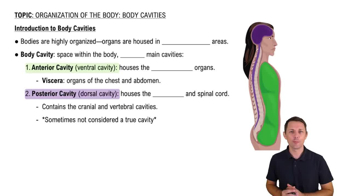
Introduction to Body Cavities

Spinal Reflex Arcs for Bowel and Bladder Control

Bowel and bladder functions are regulated by spinal reflex arcs located in the sacral spinal cord. These reflexes coordinate the contraction and relaxation of internal (smooth muscle) and external (skeletal muscle) sphincters to control waste elimination, often operating independently of brain input.
추천 영상:
4:03
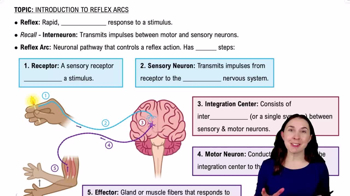
Introduction to Reflex Arcs

Effects of Spinal Cord Transection on Autonomic and Somatic Control

A transection at L1 disrupts communication between the brain and sacral reflex centers, leading to loss of voluntary control but preservation of reflex activity below the lesion. This typically results in reflex (spastic) bowel and bladder function, where reflexes remain but voluntary control is impaired.
추천 영상:
1:50
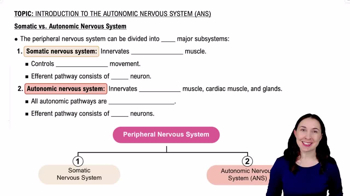
Somatic vs. Autonomic Nervous System