Ch. 13 The Spinal Cord, Spinal Nerves, and Spinal Reflexes
Martini - Fundamentals of Anatomy & Physiology 11th Edition
Martini, Nath, Bartholomew11th EditionFundamentals of Anatomy & PhysiologyISBN: 9780136874089당신이 사용하는 게 아니라요?교과서 변경
13장, 문제 18

Polysynaptic reflexes can produce far more complicated responses than can monosynaptic reflexes because
(a) The response time is quicker.
(b) The response is initiated by highly sensitive receptors.
(c) Motor neurons carry impulses at a faster rate than do sensory neurons.
(d) The interneurons involved can control several muscle groups.

검증된 단계별 안내
1
Step 1: Understand the difference between monosynaptic and polysynaptic reflexes. Monosynaptic reflexes involve a single synapse between a sensory neuron and a motor neuron, leading to a simple and quick response.
Step 2: Recognize that polysynaptic reflexes involve one or more interneurons between the sensory and motor neurons, allowing for more complex processing and integration of information.
Step 3: Consider how the presence of interneurons in polysynaptic reflexes enables coordination of multiple muscle groups, which can produce more complicated responses compared to the direct pathway in monosynaptic reflexes.
Step 4: Evaluate each option in the problem: (a) response time is quicker - this is generally false for polysynaptic reflexes because additional synapses slow the response; (b) response initiated by highly sensitive receptors - this is not the main reason for complexity; (c) motor neurons carry impulses faster than sensory neurons - this is unrelated to complexity; (d) interneurons can control several muscle groups - this explains the ability to produce more complicated responses.
Step 5: Conclude that the correct explanation is that interneurons involved in polysynaptic reflexes can control several muscle groups, allowing for more complex and coordinated responses.

비슷한 문제에 대한 검증된 영상 답변:

이 영상 해법은 위 문제에 도움이 된다고 튜터들이 추천한 것입니다.
도움이 되었나요?

주요 개념

질문에 올바르게 답하기 위해 반드시 이해해야 하는 핵심 개념들은 다음과 같습니다.

Polysynaptic Reflexes

Polysynaptic reflexes involve one or more interneurons between the sensory input and motor output neurons, allowing for complex processing and coordination. This complexity enables the reflex to affect multiple muscles and produce varied responses, unlike simpler reflexes.
추천 영상:
3:01
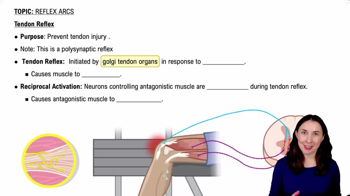
Tendon Reflex

Monosynaptic Reflexes

Monosynaptic reflexes involve a direct synapse between a sensory neuron and a motor neuron, resulting in a rapid but simple response. These reflexes typically control a single muscle group and have limited capacity for complex actions.
추천 영상:
3:37
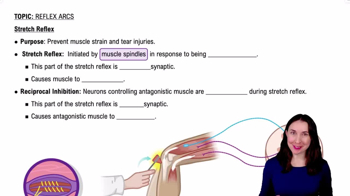
Stretch Reflex

Role of Interneurons in Reflex Arcs

Interneurons act as connectors within the spinal cord, integrating sensory input and coordinating motor output. In polysynaptic reflexes, interneurons enable communication with multiple motor neurons, allowing control over several muscle groups and more sophisticated responses.
추천 영상:
4:03
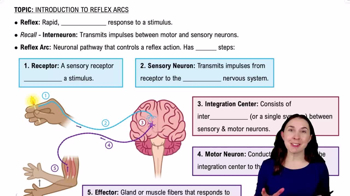
Introduction to Reflex Arcs