Ch. 17 The Special Senses
Martini - Fundamentals of Anatomy & Physiology 11th Edition
Martini, Nath, Bartholomew11th EditionFundamentals of Anatomy & PhysiologyISBN: 9780136874089당신이 사용하는 게 아니라요?교과서 변경
17장, 문제 10

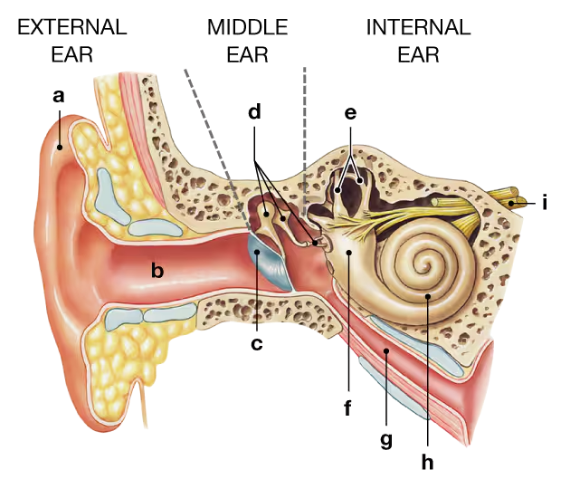
Identify the structures of the external, middle, and internal ear in the following figure.
Diagram of the external, middle, and internal ear with labeled anatomical structures a through i.
a. ___
b. ___
c. ___
d. ___
e. ___
f. ___
g. ___
h. ___
i. ___

검증된 단계별 안내
1
Step 1: Understand the three main regions of the ear: the external ear, middle ear, and internal ear. The external ear includes structures that collect sound waves, the middle ear contains ossicles that transmit vibrations, and the internal ear houses sensory organs for hearing and balance.
Step 2: Identify the external ear structures, which typically include the auricle (pinna) and the external auditory canal. These are the parts visible from outside and lead sound waves inward.
Step 3: Locate the middle ear components, which are found within the tympanic cavity. These include the tympanic membrane (eardrum) and the three auditory ossicles: malleus, incus, and stapes. These bones amplify and transmit sound vibrations to the inner ear.
Step 4: Recognize the internal ear structures, which consist of the cochlea (responsible for hearing), vestibule, and semicircular canals (both involved in balance). These are housed within the bony labyrinth of the temporal bone.
Step 5: Match each labeled part (a through i) in the figure to these categories by comparing their location and shape to the known anatomy of the ear regions, assigning each label to either external, middle, or internal ear structures accordingly.

비슷한 문제에 대한 검증된 영상 답변:

이 영상 해법은 위 문제에 도움이 된다고 튜터들이 추천한 것입니다.
도움이 되었나요?

주요 개념

질문에 올바르게 답하기 위해 반드시 이해해야 하는 핵심 개념들은 다음과 같습니다.

Anatomy of the External Ear

The external ear includes the auricle (pinna) and the external auditory canal. It collects sound waves and directs them toward the tympanic membrane (eardrum). Understanding its structures helps identify parts visible or accessible from outside the head.
추천 영상:
3:44
External Anatomy

Anatomy of the Middle Ear

The middle ear is an air-filled cavity containing the tympanic membrane and ossicles (malleus, incus, stapes). These bones transmit sound vibrations from the eardrum to the inner ear. Recognizing these components is essential for identifying the middle ear structures.
추천 영상:
4:14
Clitoral Anatomy

Anatomy of the Internal Ear

The internal ear consists of the cochlea, vestibule, and semicircular canals, responsible for hearing and balance. It converts mechanical vibrations into nerve impulses. Knowing these parts aids in distinguishing the internal ear structures in diagrams.
추천 영상:
6:14
Internal Anatomy