
교과서 질문
Plasma contributes approximately _____ percent of the volume of whole blood, and water accounts for _____ percent of the plasma volume.
(a) 55, 92
(b) 25, 55
(c) 92, 55
(d) 35, 72
1178
views

 검증된 단계별 안내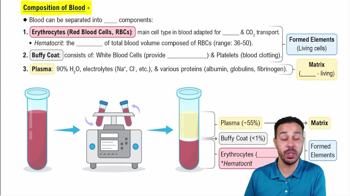
 7:49
7:49
 9:16
9:16 03:04
03:04Plasma contributes approximately _____ percent of the volume of whole blood, and water accounts for _____ percent of the plasma volume.
(a) 55, 92
(b) 25, 55
(c) 92, 55
(d) 35, 72
Stem cells responsible for lymphocytopoiesis are located in:
(a) The thymus and spleen
(b) The lymph nodes
(c) The red bone marrow
(d) All of these structures
The following is a list of the phases involved in the process of hemostasis:
The correct sequence of these phases is:
(a) 5, 1, 4, 2, 3
(b) 3, 5, 1, 4, 2
(c) 2, 3, 5, 1, 4
(d) 3, 5, 4, 1, 2
(e) 4, 3, 5, 2, 1
Blood temperature is approximately ___, and blood pH averages ___.
(a) 36 °C, 7.0
(b) 39 °C, 7.8
(c) 38 °C, 7.4
(d) 37 °C, 7.0
The formed elements of the blood include:
(a) Plasma, fibrin, and serum
(b) Albumins, globulins, and fibrinogen
(c) WBCs, RBCs, and platelets
(d) All of these
A hemoglobin molecule is composed of:
(a) Two protein chains
(b) Three protein chains
(c) Four protein chains and nothing else
(d) Four protein chains and four heme groups
(e) Four heme groups but no protein