
Ch. 21 Blood Vessels and Circulation
Martini - Fundamentals of Anatomy & Physiology 11th Edition
Martini, Nath, Bartholomew11th EditionFundamentals of Anatomy & PhysiologyISBN: 9780136874089당신이 사용하는 게 아니라요?교과서 변경
21장, 문제 17

What are the primary forces that cause fluid to move?
(a) Out of a capillary at its arterial end and into the interstitial fluid
(b) Into a capillary at its venous end from the interstitial fluid?

검증된 단계별 안내
1
Step 1: Understand that fluid movement across capillary walls is primarily governed by two forces: hydrostatic pressure and osmotic (oncotic) pressure. Hydrostatic pressure pushes fluid out of the capillaries, while osmotic pressure pulls fluid into the capillaries.
Step 2: For part (a), at the arterial end of a capillary, the hydrostatic pressure inside the capillary is higher than the osmotic pressure, which causes fluid to move out of the capillary into the interstitial fluid. Identify this as the primary driving force for fluid filtration.
Step 3: For part (b), at the venous end of a capillary, the hydrostatic pressure decreases, and the osmotic pressure (due to plasma proteins) becomes relatively higher. This difference causes fluid to move from the interstitial fluid back into the capillary, a process called reabsorption.
Step 4: Summarize the forces for each end: (a) fluid moves out due to higher capillary hydrostatic pressure compared to osmotic pressure, and (b) fluid moves in due to higher osmotic pressure compared to hydrostatic pressure.
Step 5: Recognize that the balance between these forces is described by Starling's equation, which quantifies net fluid movement across capillaries based on hydrostatic and osmotic pressures inside and outside the capillary.

비슷한 문제에 대한 검증된 영상 답변:

이 영상 해법은 위 문제에 도움이 된다고 튜터들이 추천한 것입니다.

주요 개념

질문에 올바르게 답하기 위해 반드시 이해해야 하는 핵심 개념들은 다음과 같습니다.

Hydrostatic Pressure

Hydrostatic pressure is the force exerted by a fluid against the walls of its container or vessel. In capillaries, it pushes fluid out of the blood vessels into the interstitial space, especially at the arterial end where this pressure is higher.
추천 영상:
6:12
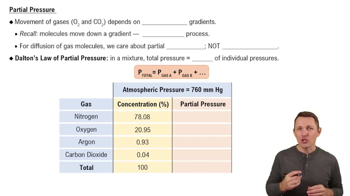
Partial Pressure

Oncotic Pressure (Colloid Osmotic Pressure)

Oncotic pressure is the osmotic pressure exerted by plasma proteins, mainly albumin, which draws water into the capillaries from the interstitial fluid. This force is stronger at the venous end of capillaries, promoting fluid reabsorption.
추천 영상:
6:12
Partial Pressure

Starling Forces

Starling forces describe the balance between hydrostatic and oncotic pressures that regulate fluid movement across capillary membranes. The interplay of these forces determines whether fluid leaves or enters the capillaries at different points along their length.
추천 영상:
5:45
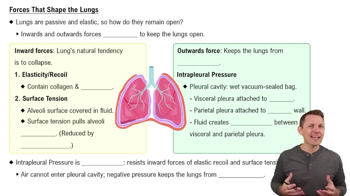
Forces That Shape the Lungs