Ch. 29 Development and Inheritance
Martini - Fundamentals of Anatomy & Physiology 11th Edition
Martini, Nath, Bartholomew11th EditionFundamentals of Anatomy & PhysiologyISBN: 9780136874089당신이 사용하는 게 아니라요?교과서 변경
28장, 문제 24d

Indicate the type of inheritance involved in each of the following situations. 
(d) The trait is expressed equally in daughters and sons.

검증된 단계별 안내
1
Understand the concept of inheritance: Inheritance refers to the transmission of genetic traits from parents to offspring. Traits can be inherited through different patterns, such as autosomal dominant, autosomal recessive, X-linked, or mitochondrial inheritance.
Analyze the statement: The problem states that the trait is expressed equally in daughters and sons. This suggests that the inheritance pattern is not sex-linked, as sex-linked traits typically show differences in expression between males and females.
Consider autosomal inheritance: Traits expressed equally in both sexes are often inherited through autosomal chromosomes, which are non-sex chromosomes. Autosomal inheritance can be dominant or recessive.
Differentiate between autosomal dominant and autosomal recessive inheritance: In autosomal dominant inheritance, only one copy of the dominant allele is needed for the trait to be expressed. In autosomal recessive inheritance, two copies of the recessive allele are required for the trait to be expressed.
Conclude the type of inheritance: Based on the information provided, the trait is likely inherited through an autosomal pattern, as it is expressed equally in daughters and sons. Further details about the dominance or recessiveness of the trait would be needed to specify the exact type of autosomal inheritance.

비슷한 문제에 대한 검증된 영상 답변:

이 영상 해법은 위 문제에 도움이 된다고 튜터들이 추천한 것입니다.
도움이 되었나요?

주요 개념

질문에 올바르게 답하기 위해 반드시 이해해야 하는 핵심 개념들은 다음과 같습니다.

Autosomal Inheritance

Autosomal inheritance refers to the transmission of traits determined by genes located on the autosomes, which are the non-sex chromosomes. In this type of inheritance, traits can be expressed equally in both males and females, as both genders have two copies of each autosome. This is crucial for understanding why a trait might appear similarly in daughters and sons.
추천 영상:
가이드 코스
01:02
Autosomal Inheritance

Dominant and Recessive Traits

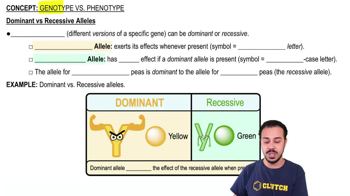
In genetics, traits can be classified as dominant or recessive based on their expression. A dominant trait will manifest in the phenotype even if only one copy of the gene is present, while a recessive trait requires two copies for expression. If a trait is expressed equally in both genders, it may indicate that it is a dominant trait, as it does not depend on the sex of the individual.
추천 영상:
가이드 코스
03:39
Dominant vs. Recessive Alleles

Sex-Linked Inheritance

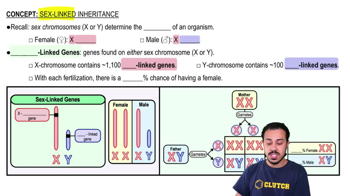
Sex-linked inheritance involves genes located on the sex chromosomes (X and Y). Traits that are sex-linked often show different patterns of expression in males and females due to the presence of one X and one Y chromosome in males, and two X chromosomes in females. If a trait is expressed equally in both daughters and sons, it suggests that the trait is not sex-linked but rather follows autosomal inheritance patterns.
추천 영상:
가이드 코스
04:17
Sex-Linked Inheritance