Ch. 29 Development and Inheritance
Martini - Fundamentals of Anatomy & Physiology 11th Edition
Martini, Nath, Bartholomew11th EditionFundamentals of Anatomy & PhysiologyISBN: 9780136874089당신이 사용하는 게 아니라요?교과서 변경
28장, 문제 10b

From which germ layers do these membranes form, and what are their functions?

검증된 단계별 안내
1
Identify the germ layers involved in embryonic development: The three primary germ layers are the ectoderm, mesoderm, and endoderm. These layers give rise to different tissues and structures in the body.
Determine which germ layers contribute to the formation of membranes: For example, the ectoderm forms structures like the skin and nervous system, the mesoderm forms connective tissues and muscles, and the endoderm forms internal linings of organs.
Understand the specific membranes formed by these germ layers: Membranes such as the amnion, chorion, and yolk sac are derived from combinations of these germ layers. For instance, the amnion is primarily formed from the ectoderm and mesoderm.
Explain the functions of these membranes: The amnion protects the embryo by enclosing it in amniotic fluid, the chorion facilitates gas exchange and contributes to the placenta, and the yolk sac provides nutrients during early development.
Summarize the relationship between germ layers and membrane functions: Highlight how the germ layers contribute to the structural and functional roles of these membranes in supporting embryonic development.

비슷한 문제에 대한 검증된 영상 답변:

이 영상 해법은 위 문제에 도움이 된다고 튜터들이 추천한 것입니다.
도움이 되었나요?

주요 개념

질문에 올바르게 답하기 위해 반드시 이해해야 하는 핵심 개념들은 다음과 같습니다.

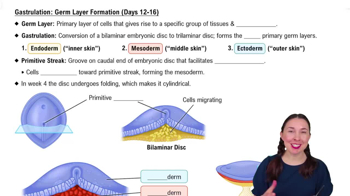
Germ Layers

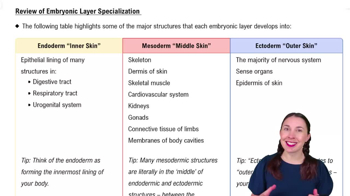
Germ layers are the primary layers of cells in the early embryo that give rise to all tissues and organs in an organism. There are three main germ layers: ectoderm, mesoderm, and endoderm. Each layer differentiates into specific structures; for example, the ectoderm forms the skin and nervous system, while the mesoderm develops into muscles and the circulatory system.
추천 영상:
3:54
Gastrulation: Germ Layer Formation (Days 12-16)

Membranes in Embryonic Development

In embryonic development, membranes such as the amnion, chorion, and yolk sac arise from the germ layers. The amnion, derived from the ectoderm and mesoderm, provides a protective fluid-filled cavity for the developing embryo. The chorion, also from the mesoderm, plays a crucial role in gas exchange and nutrient transfer, while the yolk sac, originating from the endoderm, is involved in early blood cell formation and nutrient absorption.
추천 영상:
0:43
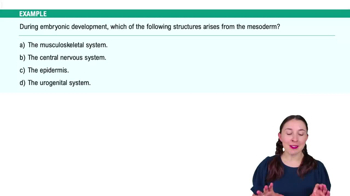
Embryonic Development (Weeks 3-8) Example 3

Functions of Embryonic Membranes

The functions of embryonic membranes are vital for the survival and development of the embryo. The amnion protects the embryo from mechanical shocks and dehydration, while the chorion facilitates the exchange of gases and nutrients between the mother and embryo. The yolk sac supports early embryonic nutrition and hematopoiesis, ensuring that the developing organism has the necessary resources for growth.
추천 영상:
3:05
Review of Embryonic Layer Specialization