Ch. 3 The Cellular Level of Organization
Martini - Fundamentals of Anatomy & Physiology 11th Edition
Martini, Nath, Bartholomew11th EditionFundamentals of Anatomy & PhysiologyISBN: 9780136874089당신이 사용하는 게 아니라요?교과서 변경
3장, 문제 17

Diffusion is important in body fluids, because it tends to
(a) Increase local concentration gradients
(b) Eliminate local concentration gradients
(c) Move substances against concentration gradients
(d) Create concentration gradients

검증된 단계별 안내
1
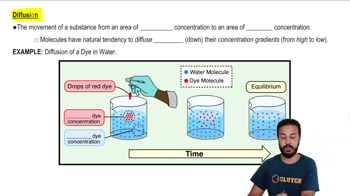
Step 1: Understand the concept of diffusion. Diffusion is the passive movement of molecules from an area of higher concentration to an area of lower concentration, driven by the concentration gradient.
Step 2: Recognize that diffusion works to balance concentrations by moving substances down their concentration gradients, not against them.
Step 3: Analyze each option in the context of diffusion: (a) Increasing local concentration gradients would mean making differences in concentration larger, which diffusion does not do; it tends to reduce these differences.
Step 4: Note that (b) Eliminating local concentration gradients aligns with diffusion's role, as diffusion moves molecules to equalize concentrations across a space.
Step 5: Conclude that diffusion does not create concentration gradients or move substances against them, so options (c) and (d) are incorrect.

비슷한 문제에 대한 검증된 영상 답변:

이 영상 해법은 위 문제에 도움이 된다고 튜터들이 추천한 것입니다.
영상 길이:
3m
도움이 되었나요?

주요 개념

질문에 올바르게 답하기 위해 반드시 이해해야 하는 핵심 개념들은 다음과 같습니다.

Diffusion

Diffusion is the passive movement of molecules from an area of higher concentration to an area of lower concentration. It occurs naturally without energy input and helps distribute substances evenly in fluids or across membranes.
추천 영상:

Concentration Gradient

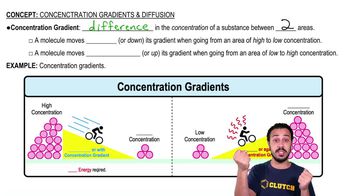
A concentration gradient is the difference in the concentration of a substance between two regions. Diffusion works to reduce or eliminate these gradients by moving molecules toward equilibrium.
추천 영상:
가이드 코스
04:51
Concentration Gradients and Diffusion

Passive Transport

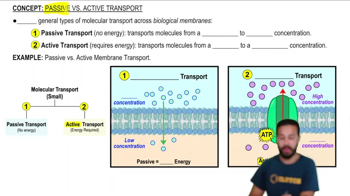
Passive transport refers to the movement of substances across cell membranes without energy use, typically down their concentration gradients. Diffusion is a type of passive transport essential for maintaining homeostasis in body fluids.
추천 영상:
가이드 코스
05:05
Passive vs. Active Transport