Ch. 3 The Cellular Level of Organization
Martini - Fundamentals of Anatomy & Physiology 11th Edition
Martini, Nath, Bartholomew11th EditionFundamentals of Anatomy & PhysiologyISBN: 9780136874089당신이 사용하는 게 아니라요?교과서 변경
3장, 문제 21

How many amino acids are coded in the DNA segment:
CTC–ATA–CGA–TTC–AAG–TTA?
(a) 18
(b) 9
(c) 6
(d) 3

검증된 단계별 안내
1
Understand that each amino acid is coded by a sequence of three nucleotides called a codon in the DNA or mRNA sequence.
Count the number of nucleotide triplets (codons) in the given DNA segment: CTC–ATA–CGA–TTC–AAG–TTA.
Since each codon corresponds to one amino acid, the total number of amino acids coded is equal to the number of codons.
Verify that the DNA segment is properly divided into codons of three nucleotides each, ensuring no incomplete codons are present.
Conclude that the number of amino acids coded is the total count of these codons.

비슷한 문제에 대한 검증된 영상 답변:

이 영상 해법은 위 문제에 도움이 된다고 튜터들이 추천한 것입니다.
영상 길이:
2m
도움이 되었나요?

주요 개념

질문에 올바르게 답하기 위해 반드시 이해해야 하는 핵심 개념들은 다음과 같습니다.

DNA Codons and Amino Acid Coding

DNA sequences are read in groups of three nucleotides called codons, each of which corresponds to a specific amino acid during protein synthesis. Understanding that each codon codes for one amino acid is essential to determine how many amino acids a DNA segment encodes.
추천 영상:
가이드 코스
11:42
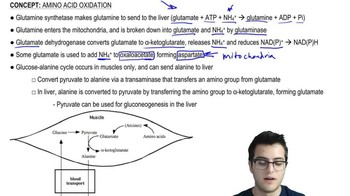
Amino Acid Oxidation 2

Reading Frame and Codon Counting

The reading frame refers to how nucleotides are grouped into codons starting from a specific nucleotide. Counting the total number of codons in a DNA segment involves dividing the total number of nucleotides by three, which directly gives the number of amino acids coded.
추천 영상:
가이드 코스
08:44
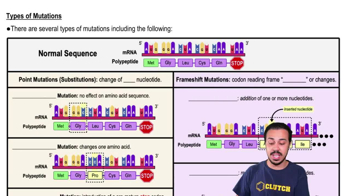
Types of Mutations

Transcription and Translation Basics

DNA is first transcribed into mRNA, which is then translated into a chain of amino acids forming a protein. Although the question focuses on DNA, knowing that the DNA codons correspond to mRNA codons helps in understanding the process of amino acid coding.
추천 영상:
가이드 코스
02:44
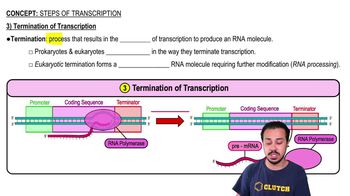
3) Termination of Transcription
관련 실천
교과서 질문

If a cell lacked ribosomes, it would not be able to

(a) Move

(b) Synthesize proteins

(c) Produce DNA

(d) Metabolize sugar

(e) Divide

145
views
교과서 질문

When a cell is placed in a(n)___solution, the cell will lose water through osmosis. This process results in the___ of red blood cells

(a) hypotonic; crenation

(b) hypertonic; crenation

(c) isotonic; hemolysis

(d) hypotonic; hemolysis

81
views
교과서 질문

List, in sequence, the phases of the interphase stage of the cell life cycle, and briefly describe what happens in each.

46
views
교과서 질문

The sodium–potassium exchange pump

(a) Is an example of facilitated diffusion

(b) Does not require the input of cellular energy in the form of ATP

(c) Moves the sodium and potassium ions along their concentration gradients

(d) Is composed of a carrier protein located in the plasma membrane

(e) Is not necessary for the maintenance of homeostasis

79
views
교과서 질문

Microvilli are found

(a) Mostly in muscle cells

(b) On the inside of plasma membranes

(c) In large numbers on cells that secrete hormones

(d) In cells that are actively engaged in absorption

(e) Only on cells lining the reproductive tract

84
views
교과서 질문

Suppose that a DNA segment has the following nucleotide sequence:

CTC–ATA–CGA–TTC–AAG–TTA.

Which nucleotide sequences would a complementary mRNA strand have?

(a) GAG–UAU–GAU–AAC–UUG–AAU

(b) GAG–TAT–GCT–AAG–TTC–AAT

(c) GAG–UAU–GCU–AAG–UUC–AAU

(d) GUG–UAU–GGA–UUG–AAC–GGU

62
views