뒤로
뒤로
문제 21
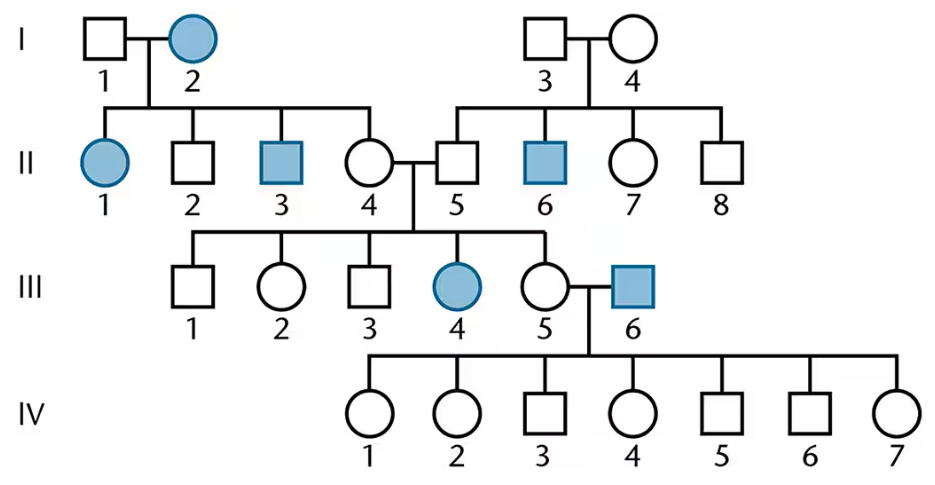
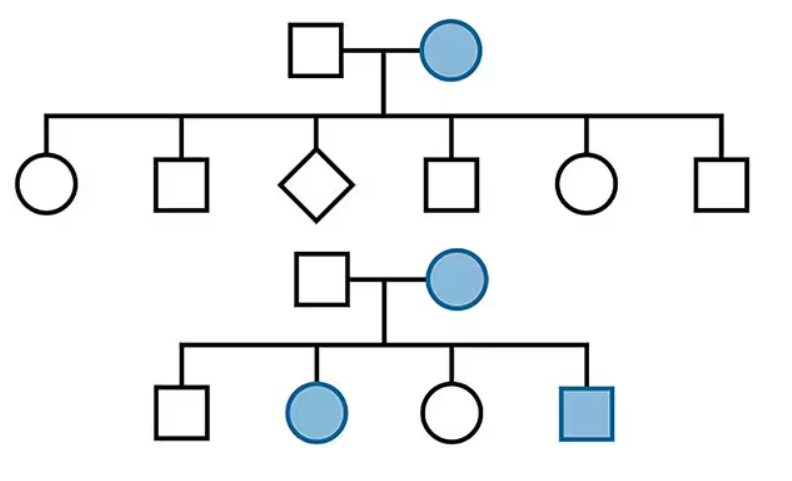
Consider the following pedigree.
Predict the mode of inheritance of the trait of interest and the most probable genotype of each individual. Assume that the alleles A and a control the expression.
문제 22a
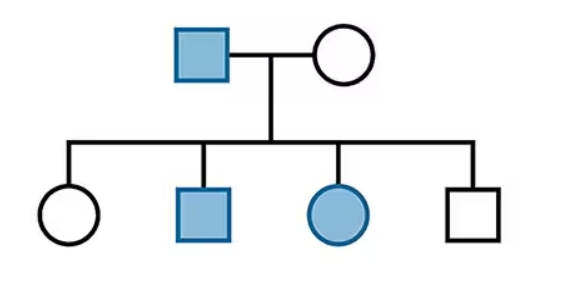
Draw all possible conclusions concerning the mode of inheritance of the trait portrayed in the following limited pedigree.
문제 22b
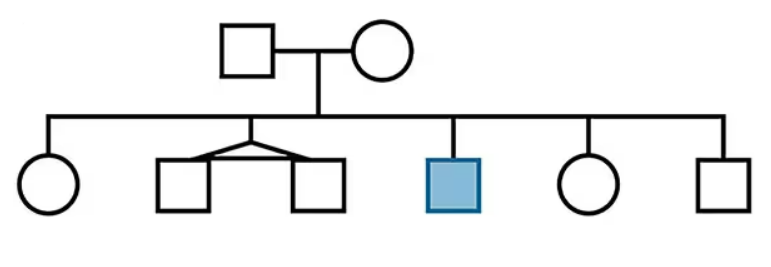
Draw all possible conclusions concerning the mode of inheritance of the trait portrayed in the following limited pedigree.
문제 22c
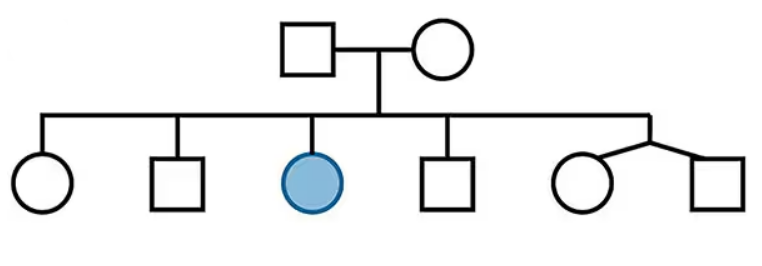
Draw all possible conclusions concerning the mode of inheritance of the trait portrayed in the following limited pedigree.
문제 22d
Draw all possible conclusions concerning the mode of inheritance of the trait portrayed in the following limited pedigree.
- For decades scientists have been perplexed by different circumstances surrounding families with rare, early-onset auditory neuropathy (deafness). In some families, parents and grandparents of the proband have normal hearing, while in other families, a number of affected (deaf) family members are scattered throughout the pedigree, appearing in every generation. Assuming a genetic cause for each case, offer a reasonable explanation for the genetic origin of such deafness in the two types of families.
문제 23
문제 24
A 'wrongful birth' case was recently brought before a court in which a child with Smith–Lemli–Opitz syndrome was born to apparently healthy parents. This syndrome is characterized by a cluster of birth defects including cleft palate, and an array of problems with the reproductive and urinary organs. Originally considered by their physician as having a nongenetic basis, the parents decided to have another child, who was also born with Smith–Lemli–Opitz syndrome. In the role of a genetic counselor, instruct the court about what occurred, including the probability of the parents having two affected offspring, knowing that the disorder is inherited as a recessive trait.
문제 25a
A 'wrongful birth' case was recently brought before a court in which a child with Smith–Lemli–Opitz syndrome was born to apparently healthy parents. This syndrome is characterized by a cluster of birth defects including cleft palate, and an array of problems with the reproductive and urinary organs. Originally considered by their physician as having a nongenetic basis, the parents decided to have another child, who was also born with Smith–Lemli–Opitz syndrome. In the role of a genetic counselor, instruct the court about what occurred, including the probability of the parents having two affected offspring, knowing that the disorder is inherited as a recessive trait. Draw a pedigree of the families of this couple, showing the relevant individuals.
문제 25b
A 'wrongful birth' case was recently brought before a court in which a child with Smith–Lemli–Opitz syndrome was born to apparently healthy parents. This syndrome is characterized by a cluster of birth defects including cleft palate, and an array of problems with the reproductive and urinary organs. Originally considered by their physician as having a nongenetic basis, the parents decided to have another child, who was also born with Smith–Lemli–Opitz syndrome. In the role of a genetic counselor, instruct the court about what occurred, including the probability of the parents having two affected offspring, knowing that the disorder is inherited as a recessive trait. Calculate the probability that both the male and female are carriers for TSD.
문제 25c
A 'wrongful birth' case was recently brought before a court in which a child with Smith–Lemli–Opitz syndrome was born to apparently healthy parents. This syndrome is characterized by a cluster of birth defects, including cleft palate, and an array of problems with the reproductive and urinary organs. Originally considered by their physician as having a nongenetic basis, the parents decided to have another child, who was also born with Smith–Lemli–Opitz syndrome. In the role of a genetic counselor, instruct the court about what occurred, including the probability of the parents having two affected offspring, knowing that the disorder is inherited as a recessive trait. What is the probability that neither of them is a carrier?
문제 25d
A 'wrongful birth' case was recently brought before a court in which a child with Smith–Lemli–Opitz syndrome was born to apparently healthy parents. This syndrome is characterized by a cluster of birth defects including cleft palate, and an array of problems with the reproductive and urinary organs. Originally considered by their physician as having a nongenetic basis, the parents decided to have another child, who was also born with Smith–Lemli–Opitz syndrome. In the role of a genetic counselor, instruct the court about what occurred, including the probability of the parents having two affected offspring, knowing that the disorder is inherited as a recessive trait. What is the probability that one of them is a carrier and the other is not? [Hint: The p values in (b), (c), and (d) should equal 1.]
문제 26a
Datura stramonium (the Jimsonweed) expresses flower colors of purple and white and pod textures of smooth and spiny. The results of two crosses in which the parents were not necessarily true breeding are shown below. Based on these results, put forward a hypothesis for the inheritance of the purple/white and smooth/spiny traits.
문제 26b
Datura stramonium (the Jimsonweed) expresses flower colors of purple and white and pod textures of smooth and spiny. The results of two crosses in which the parents were not necessarily true breeding are shown below. Assuming that true-breeding strains of all combinations of traits are available, what single cross could you execute and carry to an F₂ generation that will prove or disprove your hypothesis? Assuming your hypothesis is correct, what results of this cross will support it?
문제 27a
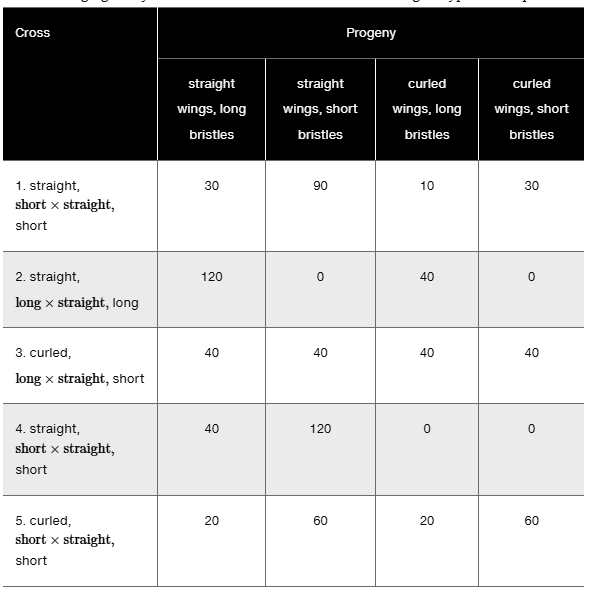
The wild-type (normal) fruit fly, Drosophila melanogaster, has straight wings and long bristles. Mutant strains have been isolated that have either curled wings or short bristles. The genes representing these two mutant traits are located on separate chromosomes. Carefully examine the data from the following five crosses.
Identify each mutation as either dominant or recessive. In each case, indicate which crosses support your answer.
문제 27b
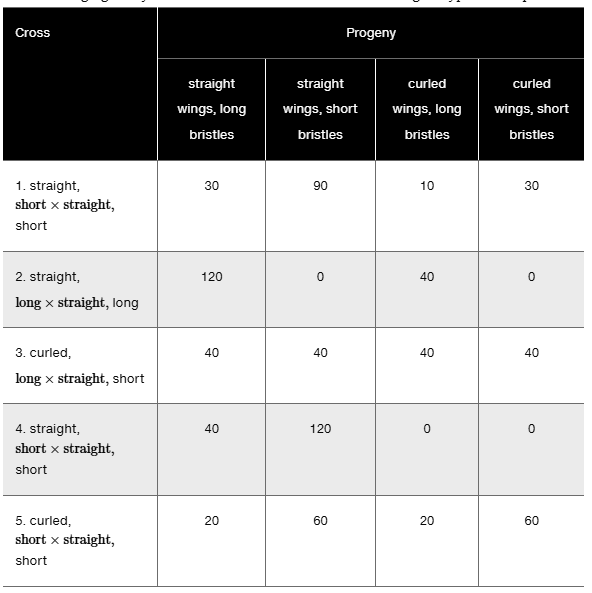
The wild-type (normal) fruit fly, Drosophila melanogaster, has straight wings and long bristles. Mutant strains have been isolated that have either curled wings or short bristles. The genes representing these two mutant traits are located on separate chromosomes. Carefully examine the data from the following five crosses.
Assign gene symbols and, for each cross, determine the genotypes of the parents.
문제 28a
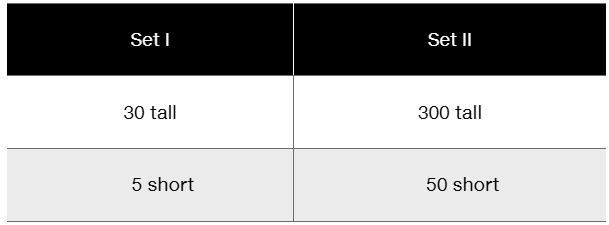
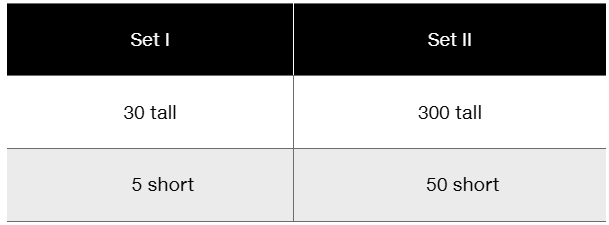
To assess Mendel's law of segregation using tomatoes, a true-breeding tall variety (SS) is crossed with a true-breeding short variety (ss). The heterozygous F₁ tall plants (Ss) were crossed to produce two sets of F₂ data, as follows.
Using the X² test, analyze the results for both datasets. Calculate X² values and estimate the p values in both cases.
문제 28b
To assess Mendel's law of segregation using tomatoes, a true-breeding tall variety (SS) is crossed with a true-breeding short variety (ss). The heterozygous F₁ tall plants (Ss) were crossed to produce two sets of F₂ data, as follows.
From the above analysis, what can you conclude about the importance of generating large datasets in experimental conditions?
문제 29a
Albinism, caused by a mutational disruption in melanin (skin pigment) production, has been observed in many species, including humans. In 1991, and again recently in 2017, the only documented observations of an albino humpback whale (named 'Migaloo') were observed near New South Wales. Recently, Polanowski and coworkers (Polanowski, A., S. Robinson-Laverick, and D. Paton. (2012). Journal of Heredity 103:130–133) studied the genetics of humpback whales from the east coast of Australia, including Migaloo. Do you think that Migaloo's albinism is more likely caused by a dominant or recessive mutation? Explain your reasoning.
문제 29b
Albinism, caused by a mutational disruption in melanin (skin pigment) production, has been observed in many species, including humans. In 1991, and again recently in 2017, the only documented observations of an albino humpback whale (named 'Migaloo') were observed near New South Wales. Recently, Polanowski and coworkers (Polanowski, A., S. Robinson-Laverick, and D. Paton. (2012). Journal of Heredity 103:130–133) studied the genetics of humpback whales from the east coast of Australia, including Migaloo. What data would be helpful in determining the answer to part (a)?
문제 30a
Albinism, caused by a mutational disruption in melanin (skin pigment) production, has been observed in many species, including humans. In 1991, and again recently in 2017, the only documented observations of an albino humpback whale (named 'Migaloo') were observed near New South Wales. Recently, Polanowski and coworkers (Polanowski, A., S. Robinson-Laverick, and D. Paton. (2012). Journal of Heredity 103:130–133) studied the genetics of humpback whales from the east coast of Australia, including Migaloo. Assuming that Migaloo's albinism is caused by a rare recessive gene, what would be the likelihood of the establishment of a natural robust subpopulation of albino white humpback whales in this population?
문제 30b
Albinism, caused by a mutational disruption in melanin (skin pigment) production, has been observed in many species, including humans. In 1991, and again recently in 2017, the only documented observations of an albino humpback whale (named 'Migaloo') were observed near New South Wales. Recently, Polanowski and coworkers (Polanowski, A., S. Robinson-Laverick, and D. Paton. (2012). Journal of Heredity 103:130–133) studied the genetics of humpback whales from the east coast of Australia, including Migaloo. Assuming that Migaloo's albinism is caused by a rare dominant gene, what would be the likelihood of the establishment of a natural robust subpopulation of albino white humpback whales in this population?