뒤로
뒤로
문제 14d
Briefly describe the contribution each of the following people made to the development of genetics or genetic analysis.
William Bateson:
문제 14e
Briefly describe the contribution each of the following people made to the development of genetics or genetic analysis.
Rudolph Virchow
문제 14f
Briefly describe the contribution each of the following people made to the development of genetics or genetic analysis.
Edmund B. Wilson
문제 15
If thymine makes up 21% of the DNA nucleotides in the genome of a plant species, what are the percentages of the other nucleotides in the genome?
문제 16
What reactive chemical groups are found at the 5' and 3' carbons of nucleotides? What is the name of the bond formed when nucleotides are joined in a single strand? Is this bond covalent or noncovalent?
문제 17
Identify two differences in chemical composition that distinguish DNA from RNA.
문제 18
What is the central dogma of biology? Identify and describe the molecular processes that accomplish the flow of genetic information described in the central dogma.
문제 19
A portion of a polypeptide contains the amino acids Trp-Lys-Met-Ala-Val. Write the possible mRNA and template-strand DNA sequences. (Hint: Use A/G and T/C to indicate that either adenine/guanine or thymine/cytosine could occur in a particular position, and use N to indicate that any DNA nucleotide could appear.)
문제 20a
The following segment of DNA is the template strand transcribed into mRNA:
5'-...GACATGGAA...-3'
What is the sequence of mRNA created from this sequence?
문제 20b
The following segment of DNA is the template strand transcribed into mRNA:
5'-...GACATGGAA...-3'
What is the amino acid sequence produced by translation?
문제 21
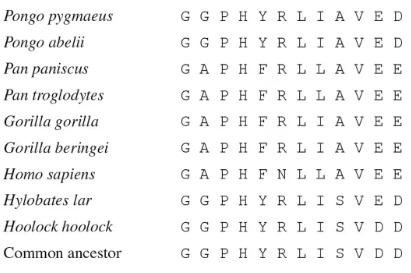
Using the following amino acid sequences obtained from different species of apes, construct a phylogenetic tree of the apes.
문제 22a
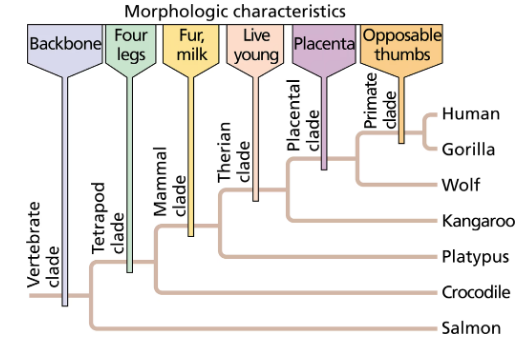
Examine the following figure and answer the following questions.
How many clades are shown in the figure?
문제 22b
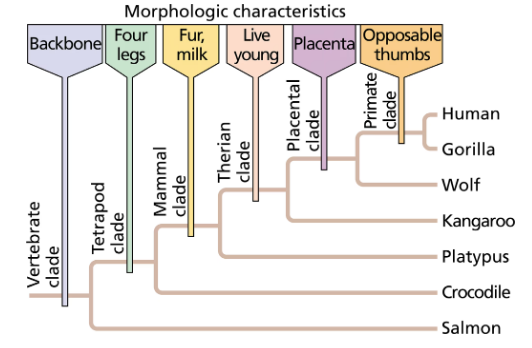
Examine the following figure and answer the following questions.
What characteristic is shared by all clades in the figure?
문제 22c
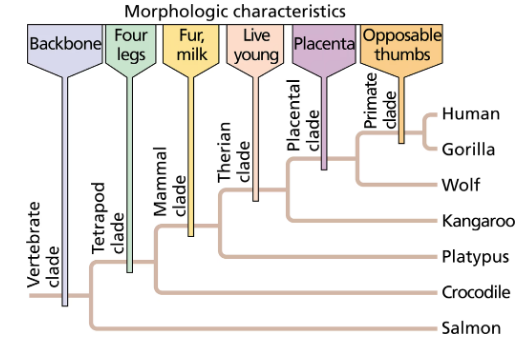
Examine the following figure and answer the following questions.
What characteristics are shared by the mammalian clade and the primate clade? What characteristic distinguishes the primates from other members of the mammalian clade?
문제 23
Fill in the missing nucleotides (so there are three per block) and the missing amino acid abbreviations in the graphic shown here.

문제 24a
Suppose a genotype for a protein-producing gene can have any combination of three alleles, A₁, A₂, and A₃.
List all the possible genotypes involving these three alleles.
문제 24b
Suppose a genotype for a protein-producing gene can have any combination of three alleles, A₁, A₂, and A₃.
Each allele produces a protein with a distinct electrophoretic mobility. Allele A₁ has the highest electrophoretic mobility, A₃ has the lowest electrophoretic mobility, and the electrophoretic mobility of A₂ is intermediate between them. Draw the appearance of gel electrophoresis protein bands for each of the possible genotypes. Be sure to label each lane of the gel with the corresponding genotype.
문제 25
Shorter fragments of DNA (those with fewer base pairs) have a higher electrophoretic mobility than larger fragments. Thinking about electrophoresis gels as creating a matrix through which fragments must migrate, briefly explain why the size of a DNA fragment affects its electrophoretic mobility.
문제 26
Four nucleic-acid samples are analyzed to determine the percentages of the nucleotides they contain. Survey the data in the table to determine which samples are DNA and which are RNA, and specify whether each sample is double-stranded or single-stranded. Justify each answer.
[A table of nucleotide percentages appears below the problem]

문제 27
What is meant by the term homology? How is that different from the meaning of homoplasmy?
문제 28
If one is constructing a phylogeny of reptiles using DNA sequence data, which taxon (birds, mammals, amphibians, or fish) might be suitable to use as an outgroup?
문제 29a
Consider the following segment of DNA:
5'-...ATGCCAGTCACTGACTTG...-3'
3'-...TACGGTCAGTGACTGAAC...-5'
How many phosphodiester bonds are required to form this segment of double-stranded DNA?
문제 29b
Consider the following segment of DNA:
5'-...ATGCCAGTCACTGACTTG...-3'
3'-...TACGGTCAGTGACTGAAC...-5'
How many hydrogen bonds are present in this DNA segment?
문제 29c
Consider the following segment of DNA:
5'-...ATGCCAGTCACTGACTTG...-3'
3'-...TACGGTCAGTGACTGAAC...-5'
If the lower strand of DNA serves as the template transcribed into mRNA, how many peptide bonds are present in the polypeptide fragment into which the mRNA is translated?
문제 30a
Ethical and social issues have become a large part of the public discussion of genetics and genetic testing. Choose two of the propositions presented here and prepare a list of arguments for and against them.
The results of genetic testing for susceptibility to cancer, heart disease, and diabetes should be available to insurance companies and current or prospective employers to provide more information for decision-making.
문제 30b
Ethical and social issues have become a large part of the public discussion of genetics and genetic testing. Choose two of the propositions presented here and prepare a list of arguments for and against them.
Prenatal genetic testing and genetic testing of newborn infants should be available for hereditary conditions that can be treated or managed.
문제 30c
Ethical and social issues have become a large part of the public discussion of genetics and genetic testing. Choose two of the propositions presented here and prepare a list of arguments for and against them.
Prenatal genetic testing and genetic testing later in life should be available for hereditary conditions that cannot currently be treated or effectively managed.
문제 30d
Ethical and social issues have become a large part of the public discussion of genetics and genetic testing. Choose two of the propositions presented here and prepare a list of arguments for and against them.
Gene therapy should be used on humans when it can correct a hereditary condition such as sickle cell disease.
문제 31a
In certain cases, genetic testing can identify mutant alleles that greatly increase a person's chance of developing a disease such as breast cancer or colon cancer. Between 50 and 70% of people with these particular mutations will develop cancer, but the rest will not. Imagine you are either a 30-year-old woman with a family history of breast cancer or a 30-year-old man with a family history of colon cancer (choose one). Each person can undergo genetic testing to identify a mutation that greatly increases susceptibility to the disease. Putting yourself in the place of the person you have chosen, provide answers to the following questions.
If you have a spouse or partner, are you obligated to tell that person the result of the genetic test? Why or why not?
문제 31b
In certain cases, genetic testing can identify mutant alleles that greatly increase a person's chance of developing a disease such as breast cancer or colon cancer. Between 50 and 70% of people with these particular mutations will develop cancer, but the rest will not. Imagine you are either a 30-year-old woman with a family history of breast cancer or a 30-year-old man with a family history of colon cancer (choose one). Each person can undergo genetic testing to identify a mutation that greatly increases susceptibility to the disease. Putting yourself in the place of the person you have chosen, provide answers to the following questions.
If you have children, are you obligated to tell the children the result of the genetic test? Why or why not?