Ch. 16 - Genomics: Genetics from a Whole-Genome Perspective
Sanders - Genetic Analysis: An Integrated Approach 3rd Edition
Sanders3rd EditionGenetic Analysis: An Integrated ApproachISBN: 9780135564172당신이 사용하는 게 아니라요?교과서 변경
16장, 문제 16b

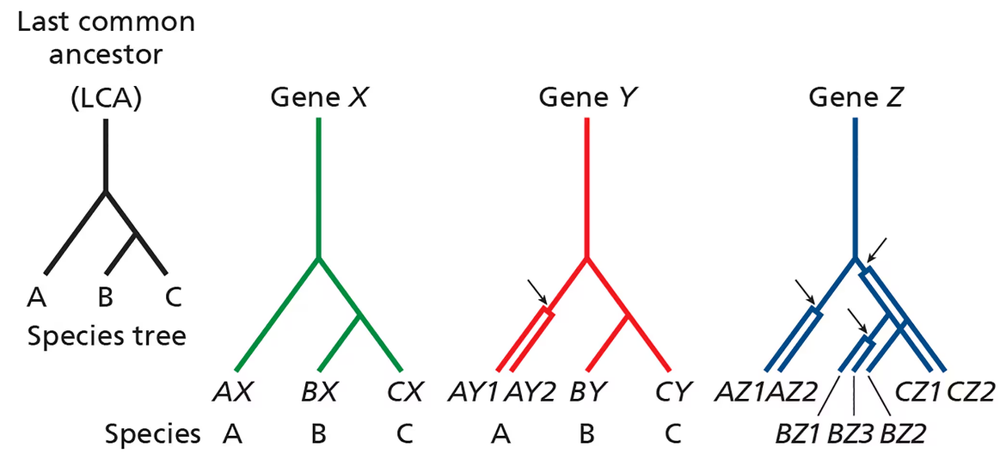
Consider the phylogenetic trees below pertaining to three related species (A, B, and C) that share a common ancestor (last common ancestor, or LCA). The lineage leading to species A diverges before the divergence of species B and C.
For gene Y, a gene duplication occurred in the lineage leading to A after it diverged from that, leading to B and C. Are genes AY1 and AY2 orthologous or paralogous? Are genes AY1 and BY orthologous or paralogous? Are genes BY and CY orthologous or paralogous?

검증된 단계별 안내
1
Understand the definitions of orthologous and paralogous genes: Orthologous genes are genes in different species that evolved from a common ancestral gene through speciation. Paralogs, on the other hand, are genes related by duplication within a genome.
Analyze the relationship between AY1 and AY2: Since the problem states that a gene duplication occurred in the lineage leading to species A after it diverged from the lineage leading to species B and C, AY1 and AY2 are paralogous because they arose from a duplication event within the same species (species A).
Examine the relationship between AY1 and BY: AY1 and BY are orthologous because they are genes in different species (A and B) that evolved from a common ancestral gene through speciation, not duplication.
Determine the relationship between BY and CY: BY and CY are orthologous because they are genes in different species (B and C) that evolved from a common ancestral gene through speciation.
Summarize the relationships: AY1 and AY2 are paralogous, AY1 and BY are orthologous, and BY and CY are orthologous. This classification is based on the evolutionary events of gene duplication and speciation described in the problem.

비슷한 문제에 대한 검증된 영상 답변:

이 영상 해법은 위 문제에 도움이 된다고 튜터들이 추천한 것입니다.
영상 길이:
2m
도움이 되었나요?

주요 개념

질문에 올바르게 답하기 위해 반드시 이해해야 하는 핵심 개념들은 다음과 같습니다.

Orthologs vs. Paralogs

Orthologs are genes in different species that evolved from a common ancestral gene through speciation, while paralogs are genes that arise from gene duplication within the same species. Understanding this distinction is crucial for analyzing gene relationships in phylogenetic trees, as it helps determine the evolutionary history and functional divergence of genes.
추천 영상:
가이드 코스
04:17
Traditional vs. Next-Gen

Gene Duplication

Gene duplication is a process where a segment of DNA is copied, resulting in two or more copies of a gene within the genome. This can lead to the formation of paralogs, as the duplicated genes may evolve new functions or retain similar functions over time. In the context of the question, the duplication in the lineage leading to species A is key to identifying the relationships between AY1, AY2, and other genes.
추천 영상:

Phylogenetic Trees

Phylogenetic trees are diagrams that represent the evolutionary relationships among various species based on their genetic information. They illustrate how species diverged from common ancestors and help visualize the lineage of genes. Analyzing these trees is essential for determining whether genes are orthologous or paralogous, as the tree structure provides insights into the timing and nature of gene divergences.
추천 영상:
가이드 코스
08:16
Phylogenetic Trees
관련 실천
교과서 질문

Select one of the hereditary conditions from either the RUSP core conditions list or the RUSP list of secondary conditions and do some online research to find the following information:

The recommended treatment for those with the condition.

447
views
교과서 질문

You have isolated a gene that is important for the production of milk and wish to study its regulation. You examine the genomes of human, mouse, dog, chicken, pufferfish, and yeast and note that all genomes except yeast have an orthologous gene.

What does the existence of orthologous genes in chicken and pufferfish tell you about the function of this gene?

439
views
교과서 질문

Consider the phylogenetic trees below pertaining to three related species (A, B, and C) that share a common ancestor (last common ancestor, or LCA). The lineage leading to species A diverges before the divergence of species B and C.

For gene X, no gene duplications have occurred in any lineage, and each gene X is derived from the ancestral gene X via speciation events. Are genes AX, BX, and CX orthologous, paralogous, or homologous?

392
views
교과서 질문

In the course of the Drosophila melanogaster genome project, the following genomic DNA sequences were obtained. Try to assemble the sequences into a single contig.

5' TTCCAGAACCGGCGAATGAAGCTGAAGAAG 3'

5' GAGCGGCAGATCAAGATCTGGTTCCAGAAC 3'

5' TGATCTGCCGCTCCGTCAGGCATAGCGCGT 3'

5' GGAGAATCGAGATGGCGCACGCGCTATGCC 3'

5' GGAGAATCGAGATGGCGCACGCGCTATGCC 3'

5' CCATCTCGATTCTCCGTCTGCGGGTCAGAT 3'

Go to the URL provided in Problem 14, and using the sequence you have just assembled, perform a blastn search in the 'Nucleotide collection (nr/nt)' database. Does the search produce sequences similar to your assembled sequence, and if so, what are they? Can you tell if your sequence is transcribed, and if it represents protein-coding sequence? Perform a tblastx search, first choosing the 'Nucleotide collection (nr/nt)' database and then limiting the search to human sequences by typing Homo sapiens in the organism box. Are homologous sequences found in the human genome? Annotate the assembled sequence.

486
views
교과서 질문

You have isolated a gene that is important for the production of milk and wish to study its regulation. You examine the genomes of human, mouse, dog, chicken, pufferfish, and yeast and note that all genomes except yeast have an orthologous gene.

How would you identify the regulatory elements important for the expression of your isolated gene in mammary glands?

532
views
교과서 질문

Consider the phylogenetic trees below pertaining to three related species (A, B, and C) that share a common ancestor (last common ancestor, or LCA). The lineage leading to species A diverges before the divergence of species B and C.

For gene Z, gene duplications have occurred in all species. Define orthology and paralogy relationships for the different Z genes.

381
views